Platform Foundation

The Cyber Resilience Act Is Now an Engineering Programme: What Connected Product Leaders Must Fund Before 2027

The EU Cyber Resilience Act is more than a compliance requirement, it is an engineering transformation. This guide explains the eight engineering capabilities manufacturers should implement, including Secure Development Lifecycle (SDL), Software Bill of Materials (SBOM), Vulnerability Exploitability eXchange (VEX), Product Security Incident Response Teams (PSIRT), secure firmware updates, continuous vulnerability monitoring, and long-term product support. Learn how to build a practical roadmap for CRA readiness before the 2026 reporting obligations and 2027 compliance deadline.

The Cyber Resilience Act Is Now an Engineering Programme: What Connected Product Leaders Must Fund Before 2027 Read More »

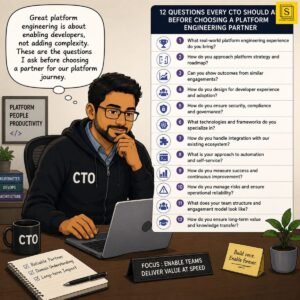
The CTO’s Guide to Choosing the Right Platform Engineering Partner: 12 Questions Every Enterprise Should Ask

Enterprise platform engineering projects succeed when organizations choose the right consulting partner. Learn the 12 key questions every CTO should ask to evaluate platform engineering consulting companies, improve developer productivity, strengthen governance, and build a scalable Internal Developer Platform that delivers measurable business outcomes.

The CTO’s Guide to Choosing the Right Platform Engineering Partner: 12 Questions Every Enterprise Should Ask Read More »

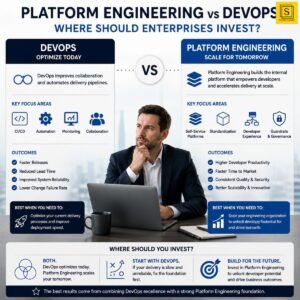
Why Platform Engineering Fails in Large Enterprises (And How to Get It Right)

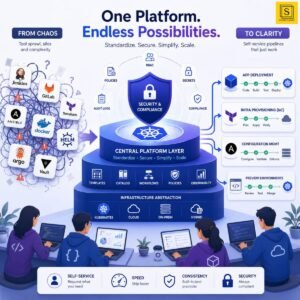
Platform engineering is rarely held back by Kubernetes or Infrastructure as Code. Most enterprise initiatives fail because developers never adopt the platform. This article explains the organisational challenges, developer experience principles and practical implementation strategies needed to build an internal developer platform that engineering teams genuinely use.

Why Platform Engineering Fails in Large Enterprises (And How to Get It Right) Read More »

CI documentation

MLOps Is Not DevOps With a GPU: The Operational Differences That Break AI Teams

Teams that treat MLOps as “DevOps with a GPU” often spend months discovering why traditional CI/CD pipelines fail under production AI workloads. Model drift, training-serving skew, non-deterministic failures, and data lineage gaps create operational problems standard DevOps systems were never designed to manage. This article explains the core operational differences between DevOps and MLOps, why production ML systems behave differently, and what mature MLOps practices actually look like inside AI-first engineering organisations.

MLOps Is Not DevOps With a GPU: The Operational Differences That Break AI Teams Read More »