
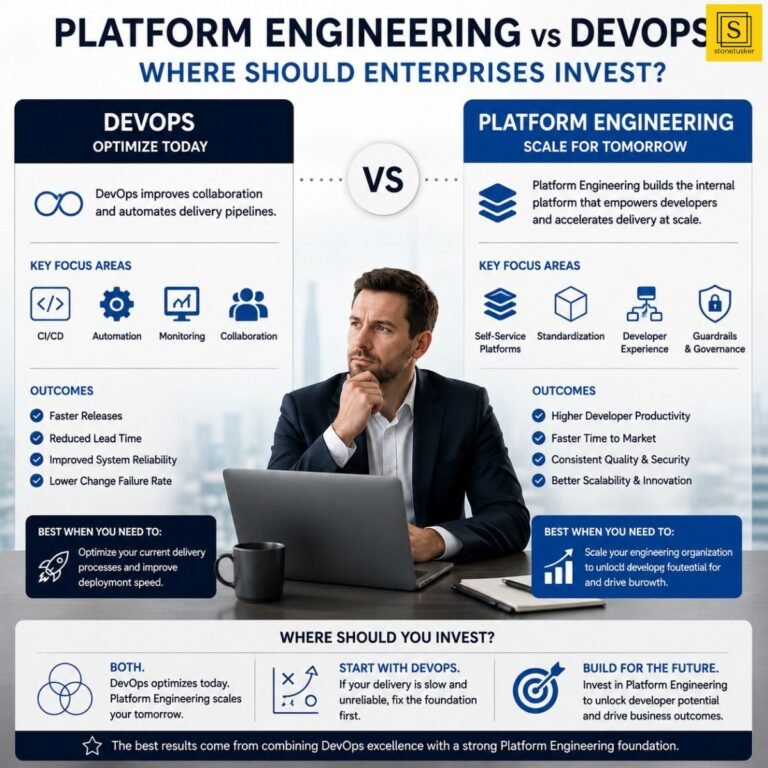
Platform Engineering vs DevOps: Where Should Enterprises Invest?
This is not a fight between DevOps and platform engineering. They solve different problems, and the real question is which one removes your biggest bottleneck next.
For more than a decade, DevOps has helped organisations ship better software by getting development and operations to work together, automating deployments and shortening release cycles. Plenty of enterprises have done the hard yards: CI/CD pipelines, Infrastructure as Code, automated testing and cloud-native operating models are all in place.
But as engineering organisations grow, a different problem creeps in. Developers start spending more and more time on infrastructure requests, configuring environments, keeping pipelines alive and decoding security requirements. DevOps is still there, yet the day-to-day developer experience somehow gets more complicated, not less.
That is where platform engineering has earned its attention. It does not replace DevOps. It builds reusable internal platforms so teams can consume infrastructure and delivery capabilities through self-service, cutting cognitive load while keeping governance, security and consistency intact.
So for technology leaders, the question is no longer whether DevOps matters. It is where the next bit of investment delivers the most operational value. Keep expanding traditional DevOps, or start building a dedicated platform engineering capability?
The honest answer depends on your maturity, team size, software complexity, compliance needs and long-term strategy. This article looks at those trade-offs from an operational angle, rather than pretending the two are rivals.
Assess your engineering delivery maturity
Before you invest in platform engineering, it helps to know where your delivery sits today. The TuskerGauge assessment gives engineering leaders a structured view of DevOps capability, automation maturity, developer experience and operational readiness.
DevOps and Platform Engineering Are Not Competing Strategies
A common myth is that platform engineering replaces DevOps. In practice it builds on the operational principles DevOps introduced.
DevOps is a way of working. It promotes collaboration, automation, continuous feedback, shared ownership and fast delivery. Platform engineering is about building products for internal engineering teams, products that simplify how developers consume infrastructure, pipelines, observability, security controls and operational services.
The distinction matters because a lot of organisations keep investing heavily in DevOps while also standing up platform teams. The platform becomes the thing that makes DevOps practices easy to apply consistently across hundreds of engineers.
Understanding DevOps
DevOps grew up to fix the long-running friction between software development and IT operations. Before it went mainstream, developers would finish a feature only to hit slow deployments, manual provisioning, inconsistent environments and almost no operational visibility.
By automating across the delivery lifecycle, DevOps lowered deployment risk and pushed teams to share responsibility for reliability. Continuous Integration, Continuous Delivery, Infrastructure as Code, automated testing, monitoring and collaborative incident response all became standard parts of modern engineering.
Its real strength is that it improves engineering culture alongside the automation. Teams own software from development through to production, which creates faster feedback and more confidence in every release.
Understanding Platform Engineering
Platform engineering tackles a different problem. As organisations scale, developers face a sprawling collection of tools, cloud services, pipelines, security requirements, compliance controls, Kubernetes clusters, observability platforms and infrastructure templates. Every project ends up solving the same operational puzzles from scratch.
Platform engineering introduces dedicated teams who build reusable internal platforms that standardise those capabilities. Instead of manually requesting infrastructure or wiring up a pipeline, developers work through self-service interfaces, templates, APIs or Internal Developer Platforms that automate the operational work and bake in organisational standards.
The result is less duplicated effort and application teams that can concentrate on business functionality rather than maintaining delivery infrastructure.
How Their Objectives Differ
| DevOps | Platform Engineering |
|---|---|
| Improves collaboration between development and operations. | Creates reusable internal engineering platforms. |
| Automates software delivery. | Provides self-service developer capabilities. |
| Encourages shared operational ownership. | Reduces developer cognitive load. |
| Focuses on delivery practices. | Focuses on developer productivity products. |
| Can be implemented within delivery teams. | Typically requires dedicated platform teams. |
Why Platform Engineering Has Become a Strategic Investment
Most organisations do not adopt platform engineering because DevOps failed. They adopt it because DevOps alone gets hard to scale as the organisation grows. What works beautifully for ten developers starts creating bottlenecks when the same setup supports hundreds of engineers across multiple business units, clouds and application portfolios.
As delivery expands, platform responsibilities get scattered across teams. Each one builds its own CI/CD pipelines, infrastructure templates, Kubernetes configs, dashboards and security integrations. Every solution works locally, but the organisation slowly collects inconsistent tooling, duplicated effort and operational complexity.
Platform engineering treats internal engineering capabilities as products. Rather than every team building deployment automation on its own, a dedicated platform team provides standard services consumed through self-service.
Business Outcomes That Matter to Engineering Leaders
Executives rarely invest in platform engineering just because it is new technology. The decision is usually driven by measurable outcomes: better efficiency, tighter governance and more consistent delivery.
1. Faster developer onboarding
One of the most immediate wins is cutting the time it takes a new engineer to become productive. Instead of spending days decoding pipelines, provisioning, networking policies and security rules, developers start from approved templates that already reflect the organisation's standards. New teams focus on building features rather than rebuilding operational foundations.
2. Reduced cognitive load
Modern engineers are expected to understand containers, Kubernetes, CI/CD, cloud networking, Infrastructure as Code, observability, secrets management, identity, compliance and application security. Those skills are valuable, but expecting every developer to master every domain is not realistic. Platform engineering hides common infrastructure tasks behind well-designed self-service interfaces. Developers keep visibility, they just do not have to configure every component by hand.
3. Improved delivery consistency
When every team builds infrastructure independently, deployment practices drift apart. Different pipeline structures, inconsistent testing stages and varying security controls all add operational risk over time. Platform teams provide reusable deployment patterns that encourage consistency without stopping teams from shipping independently. That improves reliability and makes governance and support simpler.
4. Better security and compliance
Security teams struggle to review dozens of independently built pipelines and templates. Platform engineering lets security requirements live inside reusable platform components, so secure defaults are part of the platform rather than an afterthought. Compliance improves and manual review effort drops.
5. Improved developer experience
Developer experience is now a serious engineering metric. Productive engineers spend more time delivering customer value and less time fighting infrastructure, requesting environments or debugging pipelines. Platform engineering removes that friction with better tooling, reusable templates, self-service infrastructure and integrated observability, all without giving up operational control.
When DevOps Alone May Be Enough
Platform engineering is not for everyone. Smaller teams with fairly simple deployment environments often do brilliantly by continuing to invest in DevOps, no dedicated platform team required. For example:
- Start-ups with fewer than 30 developers running a handful of services.
- Teams on a single cloud with consistent deployment practices.
- Product organisations where infrastructure needs stay fairly stable.
- Businesses that have not yet standardised CI/CD or Infrastructure as Code.
For these organisations, improving DevOps maturity usually delivers more value than adding another engineering function.
When Platform Engineering Delivers Greater Value
A dedicated platform team earns its keep when the friction is coming from growth rather than a lack of technical skill. Watch for:
- Multiple product teams maintaining separate pipelines for similar workloads.
- Infrastructure requests regularly holding up delivery.
- Developers spending significant time configuring Kubernetes, networking and cloud resources.
- Security controls varying across projects despite common compliance needs.
- Leaders struggling to enforce consistent standards across teams.
- Onboarding taking weeks because every project does delivery differently.
These are signs that operational complexity has become an organisational problem, not a technical one.
Typical Outcomes Teams Measure After Adoption
- Engineering teams commonly spend less time building pipelines because reusable templates provide standard delivery workflows.
- Platform teams often improve infrastructure consistency by standardising Infrastructure as Code modules and deployment policies across teams.
- Developers generally get faster access to environments through self-service provisioning instead of manual requests.
- Security teams frequently gain better visibility because compliance controls live inside reusable platform components.
- Leaders often see more operational consistency as teams adopt common deployment standards.
Planning a Platform Engineering Initiative?
Building an Internal Developer Platform is about more than picking tools. Team structure, governance, developer workflows and operational ownership all shape whether it succeeds.
If you are evaluating platform engineering, talk through your delivery challenges with an experienced engineering consultant before locking in architecture or tooling.
Platform Engineering Is an Evolution of DevOps
The most successful enterprises do not see platform engineering and DevOps as competing bets. DevOps sets the cultural and operational principles that make fast, reliable delivery possible. Platform engineering provides the scalable internal capabilities that let those principles be applied consistently across a much larger organisation.
So rather than replacing DevOps, platform engineering helps teams apply DevOps with less operational overhead, better governance and a noticeably better developer experience.
Where Should Enterprises Invest First?
For most leaders, this is not a straight choice between DevOps and platform engineering. The real question is which capability removes the biggest delivery constraints over the next three to five years.
Before standing up a platform team, look hard at the maturity of your existing DevOps practices. Platform engineering cannot paper over shaky source control, unreliable pipelines, thin test automation or fragmented ownership. A platform built on weak foundations just scales the existing problems.
The practical strategy is to strengthen core DevOps first, then introduce platform engineering where standardisation and self-service deliver measurable value.
Investment priority 1: Standardise DevOps foundations
If you still lean on manual deployments or inconsistent release processes, fix the fundamentals before expanding platform capabilities.
- Establish reliable Continuous Integration pipelines for every application.
- Automate software testing wherever it is practical.
- Adopt Infrastructure as Code for repeatable provisioning.
- Put consistent monitoring and observability across production systems.
- Build security checks into pipelines instead of running them separately.
These reduce operational risk and create a stable base for future platform work.
Investment priority 2: Improve developer experience
Once delivery is predictable, find where developers lose the most productive time. In a lot of organisations they wait on provisioning, configure environments by hand, duplicate pipelines or wrestle with inconsistent documentation. Platform engineering removes those recurring frustrations by delivering reusable capabilities instead of asking every team to solve the same problems again.
Investment priority 3: Build reusable platform services
Rather than launching an Internal Developer Platform as one giant transformation, most successful organisations start with a small set of reusable services that address common needs.
- Standard CI/CD pipeline templates.
- Self-service Kubernetes namespaces.
- Approved Infrastructure as Code modules.
- Centralised secrets management.
- Logging and observability templates.
- Developer documentation portals.
- Golden path application templates.
Each service should solve a real operational problem that several teams actually feel.
How Team Structures Typically Evolve
Platform engineering changes responsibilities more than it changes technology. Instead of every delivery team maintaining the same operational capabilities, a dedicated platform team owns the reusable engineering products.
Traditional DevOps model
- Each application team owns its CI/CD pipelines.
- Infrastructure knowledge is spread across delivery teams.
- Developers often build deployment automation independently.
- Operational practices vary between projects.
Platform engineering model
- A dedicated platform team builds reusable internal products.
- Application teams consume platform capabilities through self-service.
- Platform engineers maintain deployment templates, infrastructure modules, observability integrations and developer tooling.
- Application teams stay responsible for delivering business functionality.
That separation lets platform specialists focus on developer productivity while product teams focus on customer-facing software.
Decision Matrix
| Scenario | Primary investment | Reason |
|---|---|---|
| Manual deployments are still common. | DevOps | Get delivery automation in place before you add platform abstraction. |
| CI/CD pipelines differ across every product team. | Platform Engineering | Reusable pipelines cut duplication and improve consistency. |
| Infrastructure provisioning is slow. | Platform Engineering | Self-service infrastructure dramatically reduces waiting time. |
| Developers spend too long configuring Kubernetes. | Platform Engineering | Golden paths simplify common deployment patterns. |
| Security reviews delay releases. | Both | DevSecOps practices and reusable platform controls should evolve together. |
| Engineering culture lacks collaboration. | DevOps | Culture cannot be fixed with platform tooling. |
Common Mistakes During Platform Engineering Adoption
Building technology before understanding developer needs
Some organisations pick their Internal Developer Platform technology before they understand where developers actually feel friction. The platforms that work solve practical problems rather than showing off technical sophistication.
Creating another operations team
A platform team should behave like a product organisation. Internal developers are the customers, and platform capabilities should evolve based on usability, adoption, documentation and measurable outcomes, not just infrastructure ownership.
Over-engineering the platform
Trying to automate every workflow from day one tends to produce platforms that are hard to maintain and slow to adopt. Incremental delivery beats trying to solve everything at once.
Ignoring organisational change
Platform engineering brings new responsibilities, ownership boundaries and collaboration models. The technical build is only part of it. Clear communication, training and stakeholder alignment matter just as much.
A Practical Migration Roadmap
Phase 1: Assess current delivery maturity
- Review CI/CD maturity.
- Evaluate deployment consistency.
- Measure developer onboarding effort.
- Identify repeated operational tasks.
Phase 2: Standardise engineering practices
- Create common deployment standards.
- Adopt Infrastructure as Code consistently.
- Introduce common observability practices.
- Embed security controls into pipelines.
Phase 3: Establish a platform team
- Define platform ownership.
- Prioritise developer experience.
- Build reusable platform services.
- Publish clear documentation.
Phase 4: Expand self-service capabilities
- Infrastructure provisioning.
- Application templates.
- Deployment automation.
- Observability integration.
- Policy enforcement.
Phase 5: Continuously improve the platform
An Internal Developer Platform is never finished. Teams, cloud platforms, security requirements and business priorities all keep changing. Platform teams should collect developer feedback, watch adoption and keep refining internal services so they keep delivering value.
Key Takeaways
- DevOps and platform engineering solve different problems, so it is rarely an either-or decision.
- DevOps sets the culture and practices; platform engineering scales them with reusable, self-service capabilities.
- Small teams with simple environments usually get more value from improving DevOps first.
- A dedicated platform team pays off when growth, not skill, is causing repeated operational friction.
- Do not build a platform on weak foundations; fix source control, CI/CD and ownership first.
- Start small with a few reusable services that solve real problems for multiple teams.
- Run the platform like a product, with developers as the customer and adoption as the measure of success.
Conclusion
The platform engineering versus DevOps debate is often framed as a choice between one and the other. In practice, strong engineering organisations know the two solve different problems.
DevOps sets the principles for reliable software delivery. It improves collaboration, encourages automation and creates shared responsibility for running software in production. Those practices stay essential no matter your size.
Platform engineering extends them by building reusable internal products that simplify delivery at scale. As you grow, platform teams reduce duplication, improve governance and give developers consistent self-service capabilities.
So instead of asking whether DevOps is obsolete, look at where the operational friction is today and invest accordingly. Strengthen DevOps and introduce platform engineering at the right moment, and you end up with a delivery ecosystem that supports both productivity and long-term growth.
Discuss Your Platform Strategy
If you are evaluating platform engineering, modernising CI/CD or trying to improve developer productivity, an independent technical assessment can pinpoint the highest-impact investment areas before you commit to a big build.
Frequently Asked Questions
1. Does platform engineering replace DevOps?
No. Platform engineering builds on DevOps rather than replacing it. DevOps sets the cultural practices and delivery processes that encourage collaboration, automation and continuous improvement. Platform engineering creates reusable internal platforms that make those practices easier to adopt consistently across larger organisations. Most enterprises invest in both, with DevOps providing the operating model and platform engineering improving scalability and developer experience.
2. When should an organisation establish a platform engineering team?
A dedicated platform team usually becomes worthwhile when several development teams start solving the same operational problems independently. Common signs include duplicated CI/CD pipelines, inconsistent provisioning, long onboarding and growing governance challenges. Smaller organisations with simple delivery environments can often keep investing in DevOps before adding a separate platform function.
3. What is an Internal Developer Platform?
An Internal Developer Platform is a set of reusable tools, services, templates and workflows built for internal engineering teams. Instead of configuring infrastructure or pipelines by hand, developers consume standardised capabilities through self-service interfaces. This improves consistency, cuts cognitive load and lets application teams focus on building features rather than maintaining tooling.
4. How does platform engineering improve developer productivity?
It removes repetitive operational work by providing reusable infrastructure templates, deployment pipelines, observability integrations and security controls. Developers no longer rebuild the same capabilities for every project, which means faster onboarding, fewer interruptions and more focus on product work without sacrificing governance or reliability.
5. Where should enterprises invest first, DevOps or platform engineering?
It depends on your current maturity. Organisations still relying on manual deployments or inconsistent CI/CD should strengthen DevOps foundations first. Enterprises with mature automation but rising operational complexity usually get more long-term value from a dedicated platform team that standardises common engineering capabilities.
About the Author
Subeesh Sivanandan is Founder and CEO of Stonetusker Systems, with more than 26 years of experience across DevOps, Platform Engineering, CI/CD, Release Engineering, Infrastructure Automation, Embedded Linux, Kubernetes and engineering transformation programmes.
He has worked with organisations including Stryker, Nokia, IP Infusion, VeriSign and CMC Ltd, helping engineering teams modernise delivery systems, improve operational reliability and build scalable engineering platforms for enterprise environments.

