Why Platform Engineering Fails in Large Enterprises (And How to Get It Right)
Most enterprises did not fail at platform engineering because they picked the wrong tools. They failed because nobody wanted to use what got built.
Over the last decade, enterprise technology leaders have poured budget into Kubernetes, Infrastructure as Code, GitOps, container platforms and every cloud-native tool on the market. And yet, a lot of those same engineering teams still ship slowly, still fight inconsistent workflows, and still deal with more operational complexity than they had before.
The thinking usually goes like this. Adopt Kubernetes, adopt Infrastructure as Code, and productivity will follow.
It rarely works out that neatly.
What most enterprises discover is that piling on more technology, without changing how developers actually consume it, just adds another layer nobody asked for.
Platform engineering was supposed to fix this. Instead of treating infrastructure as a pile of tools looked after by an operations team, the idea is to build an internal platform that lets developers provision infrastructure, deploy applications and use engineering services through consistent self-service workflows.
The problem is that a lot of these programmes never deliver. The clusters get provisioned. The GitOps pipelines get wired up. The Terraform modules get written. And developers carry on doing things manually, or quietly route around the platform altogether.
The tooling is almost never the reason. The reason is usually the absence of a clear strategy that balances developer experience, governance, operational standards and, honestly, plain old organisational change.
This article walks through why enterprise platform engineering initiatives stall, what actually causes the poor adoption, and how to build something engineers genuinely reach for.
Platform Engineering Is More Than Kubernetes
There is a common assumption that platform engineering is just a fancier word for Kubernetes.
It is not.
Kubernetes is an orchestration platform. Platform engineering is an organisational capability. Its job is to improve software delivery by giving developers secure, reusable and standardised engineering services.
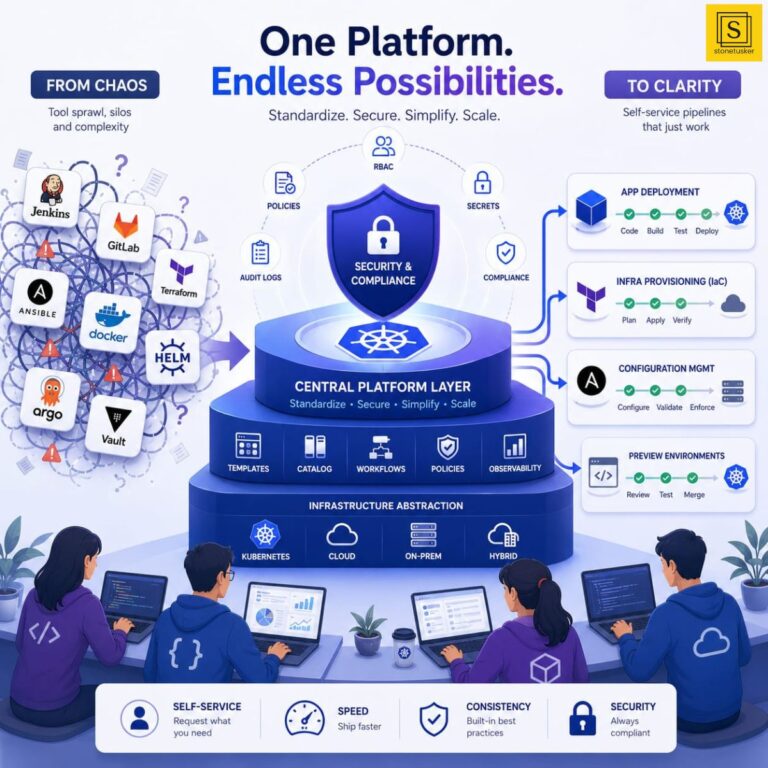
A modern enterprise platform usually pulls together several things:
- Infrastructure provisioning through Infrastructure as Code.
- Standardised CI/CD pipelines.
- Self-service environment creation.
- Application deployment automation.
- Security guardrails.
- Observability services.
- Developer documentation and onboarding.
- Governance and policy enforcement.
These might be built on Kubernetes, Terraform, GitHub Actions, GitLab CI, Argo CD or Backstage. But those are implementation choices. They are not the platform itself.
The real point of all this is to reduce the mental load on developers while keeping operations consistent across the business.
Assess Your Engineering Platform Maturity
Before you buy more tooling, it helps to know where you actually stand today. TuskerGauge lets engineering leaders evaluate delivery maturity, automation practices, governance and developer experience, so platform investments get prioritised against real operational needs.
Why Platform Engineering Initiatives Fail
Most of the ones that go wrong follow a strikingly similar script.
A platform team gets stood up. Kubernetes clusters get deployed. Infrastructure as Code goes in. GitOps workflows get implemented. Documentation gets published.
Six months later, application teams are working almost exactly the way they were before.
The platform exists on paper.
Hardly anyone is using it.
This is rarely a sign of bad engineering. It is usually a sign that the team misunderstood what platform engineering was supposed to achieve in the first place. Adopting technology does not, on its own, transform anything.
1. Platform Teams Build Infrastructure Instead of Products
A lot of organisations accidentally treat their internal platform like just another infrastructure project.
The infrastructure team focuses on clusters, networking, automation scripts and deployment tooling, and quietly assumes developers will adapt to the new workflows because, well, they should.
The teams that get this right work completely differently.
They treat the platform as an internal product. Their customers are developers. And every feature gets weighed against a single question.
Does this make shipping software easier for engineering teams?
When developer experience is the design principle, adoption tends to look after itself. When infrastructure optimisation becomes the goal instead, adoption usually drops.
Typical symptoms
- Developers need a wall of documentation before their first deployment.
- Onboarding a new application takes weeks instead of hours.
- Different business units run different deployment workflows.
- Infrastructure requests still need manual approval.
- Engineers burn real time just understanding how the platform works internally.
All of this adds mental load rather than removing it. And eventually developers route around the platform, because the unofficial path is simply faster.
2. Technology Choices Become the Strategy
Another common way things go sideways is when the team spends more energy choosing tools than defining outcomes.
The conversation drifts towards products almost immediately.
- Which Kubernetes distribution do we standardise on?
- Argo CD or Flux?
- Which service mesh gives us the best observability?
- Do we stick with Terraform for Infrastructure as Code?
These are real architectural decisions. But they are implementation details, not business outcomes.
The questions that matter more are these.
- Can developers spin up environments without raising an infrastructure ticket?
- Can application teams deploy securely without knowing Kubernetes internals?
- Can compliance policies apply themselves automatically?
- Does onboarding actually get faster?
- Are teams spending less time babysitting delivery pipelines?
The programmes that work start with developer workflows and operational outcomes, and only then pick the technology.
3. There Is No Internal Developer Platform
Plenty of organisations believe they have done platform engineering because they have Kubernetes, Infrastructure as Code and GitOps in place. But developers are still poking at infrastructure, pipelines and cloud resources directly.
This is where a lot of initiatives quietly run out of steam.
An Internal Developer Platform, or IDP, sits between developers and the underlying infrastructure. Rather than expecting every team to understand Kubernetes manifests, networking policies or cloud provisioning, it exposes self-service capabilities through simple interfaces.
A good IDP lets developers:
- Create development environments without raising infrastructure requests.
- Deploy applications through standardised workflows.
- Reach logging, monitoring and secrets management through predefined services.
- Provision databases, messaging and storage from approved templates.
- Apply security and compliance controls automatically at deploy time.
The goal is not to hide infrastructure completely. It is to strip away the unnecessary complexity while the platform team keeps operational standards intact.
Without an IDP, every team ends up building its own deployment process. Over time those little differences pile up, operational overhead grows, and consistency across the organisation quietly erodes.
4. Too Many Tools Create More Complexity
Platform engineering often starts with the best intentions and slowly collects an alarming number of tools.
A typical enterprise setup might include:
- Kubernetes for container orchestration.
- Terraform for infrastructure provisioning.
- Argo CD for GitOps.
- GitHub Actions or GitLab CI for continuous integration.
- Vault for secrets management.
- Prometheus and Grafana for observability.
- Istio or Linkerd for the service mesh.
- Several cloud provider consoles.
On its own, each tool solves a genuine problem. Together, they can bury a development team.
Developers should be delivering business value, not becoming part-time experts in eight different infrastructure tools. That growing cognitive load is one of the biggest reasons platforms never get adopted.
Signs of tool sprawl
- Developers touch five or more dashboards during a normal deployment.
- Every application team keeps its own CI/CD pipeline.
- Different business units follow different deployment standards.
- Infrastructure modules are copied and pasted across repositories.
- Operational knowledge lives inside a handful of senior engineers.
Good platform engineering reduces the number of decisions a developer has to make. It does not just centralise more tools in one place.
Not Sure Why Your Platform Strategy Is Stalling?
A lot of engineering organisations can see the symptoms of platform failure but struggle to name the underlying cause. Stonetusker works with enterprise teams to assess developer workflows, platform architecture, governance and delivery processes before recommending practical, business-aligned improvements.
5. Governance Shows Up Too Late
Many initiatives chase speed early on. Security policies, compliance controls and operational governance get pushed down the road, often until the platform is already running production workloads.
That almost always creates friction later.
As more teams pile on, inconsistent deployment practices start appearing. Security teams bolt on manual approvals, compliance reviews stretch out, and deployment velocity quietly grinds down.
Effective platform engineering treats governance as a capability of the platform, not an external process that happens to it. It gets built into every deployment workflow through automation.
What that looks like in practice
- Policy-as-Code for infrastructure validation.
- Automated security scanning inside CI/CD pipelines.
- Role-based access controls.
- Infrastructure approval workflows.
- Configuration drift detection.
- Automated audit logging.
When governance is part of the platform rather than an extra manual step, teams move faster without cutting corners on organisational standards.
6. Compliance Cannot Be an Afterthought
Large enterprises in healthcare, financial services, telecommunications and government carry strict regulatory obligations. Ignore them, and production rollout tends to hit painful delays.
Modern platforms should handle compliance through automation instead of scrambling to collect evidence by hand.
That usually means capabilities like:
- Immutable deployment records.
- Infrastructure version history.
- Automated security reporting.
- Continuous compliance validation.
- Infrastructure drift monitoring.
- Centralised secrets management.
Bake compliance into the platform and audit preparation gets lighter, while deployment confidence goes up.
7. Measuring the Wrong Things
A lot of platform teams grade themselves on infrastructure metrics.
- Number of Kubernetes clusters.
- Terraform modules created.
- CI/CD pipelines migrated.
- Infrastructure repositories.
- Cloud migration progress.
These tell you how much got built. They tell you very little about business value.
Engineering leaders are better off tracking outcomes that reflect developer productivity and delivery performance.
Metrics worth watching
- Developer onboarding time.
- Deployment frequency.
- Lead time for production changes.
- Infrastructure provisioning time.
- Platform adoption across engineering teams.
- Deployment success rate.
- Mean time to recovery.
- Developer satisfaction.
The DORA metrics give you a solid baseline for engineering performance, but pair them with developer experience metrics so you can actually tell whether the platform is improving day-to-day work. In the end, a platform is judged by how willingly people adopt it and how well it moves software delivery forward.
A Practical Platform Engineering Maturity Model
Most organisations do not jump straight to a polished internal developer platform. They move through stages, and it helps to know which one you are in before deciding what to change.
| Maturity level | Typical characteristics | Primary constraint |
|---|---|---|
| Level 1 - Ad hoc infrastructure | Manual provisioning, ticket-driven requests, tribal knowledge. | Speed and consistency. |
| Level 2 - Tooling adopted | Kubernetes, IaC and GitOps in place, but developers use them directly. | Cognitive load on developers. |
| Level 3 - Standardised delivery | Reusable pipelines, shared modules, automated quality gates. | Governance and drift. |
| Level 4 - Internal developer platform | Self-service provisioning, golden paths, embedded guardrails. | Developer experience. |
| Level 5 - Self-service at scale | Automated compliance, observable platform, product-style ownership. | Organisation-wide scalability. |
A surprising number of enterprises sit between Level 2 and Level 3. They have bought and installed the technology, but the architecture around it still reflects the assumptions made when far fewer teams were involved.
Typical Outcomes Teams Measure After Implementation
- Engineering teams often cut environment provisioning time by swapping manual infrastructure requests for self-service workflows.
- Platform teams usually improve deployment consistency once delivery pipelines are standardised across multiple groups.
- Security teams gain far better visibility through automated policy enforcement and centralised audit trails.
- Developers spend less time wrangling infrastructure and more time building features.
- Engineering leadership gets consistent metrics that support data-driven investment decisions.
How Stonetusker Delivers a 90-Day Platform Engineering Transformation
Technology alone will not give you a platform engineers rely on. The programmes that work combine modern tooling with developer experience, governance, automation and outcomes you can actually measure.
Stonetusker treats platform engineering as an implementation programme, not a technology drop. The aim is a platform teams adopt because it makes delivery easier, while still meeting enterprise security and compliance requirements.
Every organisation has different priorities, but a typical engagement runs over roughly ninety days.
Phase 1: Discovery and assessment (Weeks 1 to 3)
We start by understanding the existing engineering landscape rather than immediately introducing new technology.
- Reviewing the current software delivery lifecycle.
- Assessing Kubernetes and cloud infrastructure.
- Evaluating Infrastructure as Code maturity.
- Reviewing CI/CD pipelines.
- Identifying developer pain points.
- Assessing governance and security controls.
- Mapping compliance requirements.
- Establishing engineering productivity baselines.
This keeps recommendations tied to business priorities instead of a generic blueprint.
Phase 2: Platform design and standardisation (Weeks 4 to 7)
Using what the assessment surfaces, the architecture gets designed around developer workflows rather than individual tools.
- Defining Internal Developer Platform capabilities.
- Standardising CI/CD workflows.
- Creating reusable Infrastructure as Code modules.
- Designing self-service deployment workflows.
- Implementing policy-based governance.
- Integrating security controls into delivery pipelines.
- Establishing observability standards.
- Cutting unnecessary tooling complexity.
The goal is a consistent experience for engineering teams, whatever sits underneath.
Phase 3: Adoption and operational enablement (Weeks 8 to 12)
The final phase makes sure the platform becomes part of everyday engineering practice.
- Developer onboarding workshops.
- Platform documentation.
- Operational runbooks.
- Platform support processes.
- Engineering metrics dashboards.
- Governance reviews.
- Knowledge transfer sessions.
- Continuous improvement recommendations.
The outcome is not just a working platform. It is a platform teams understand, trust and keep using.
Planning a Platform Engineering Transformation?
If your teams are wrestling with fragmented tooling, inconsistent deployment processes or low platform adoption, Stonetusker can assess your current environment and put together a practical roadmap tailored to your organisation.
Key Takeaways
- Platform engineering failures are almost always about adoption and ownership, not the tools.
- Treat the platform as an internal product with developers as the customer, and adoption follows.
- Without an Internal Developer Platform, every team reinvents its own delivery process and consistency erodes.
- More tools mean more cognitive load; good platforms reduce the decisions developers have to make.
- Build governance and compliance into the platform through automation instead of bolting them on later.
- Measure developer productivity and delivery outcomes, not the number of clusters or modules you built.
- Start by understanding the real engineering problems before choosing any technology.
Conclusion
Platform engineering is not defined by Kubernetes, GitOps or Infrastructure as Code. Those are useful building blocks, but they do not make engineering more productive on their own.
The programmes that succeed put developer experience first, simplify delivery, wire governance into automation, and give teams self-service capabilities they genuinely want. When you treat the platform as an internal product rather than an infrastructure project, you are in a far better position to improve delivery while keeping operations consistent and compliant.
And the best initiatives almost always start the same way. They understand the real engineering challenges first, then pick technology to match, so the investment solves an actual problem instead of adding another layer of complexity.
Frequently Asked Questions
1. What is platform engineering?
Platform engineering is the practice of building and running an internal platform that gives developers self-service access to infrastructure, deployment pipelines, security, observability and everyday operational workflows. The goal is to improve developer productivity while keeping standardisation and governance consistent across the organisation.
2. How is platform engineering different from DevOps?
DevOps is about improving collaboration between development and operations so teams can ship faster. Platform engineering builds the reusable internal platform that makes DevOps practices work at scale, giving developers standardised tools, automation and self-service capabilities instead of asking every team to solve the same problems again.
3. Why do platform engineering initiatives fail?
Most fail because organisations focus on technology instead of developer experience. The usual causes are poor adoption, too many tools, governance added too late, no internal developer platform, compliance treated as an afterthought, and measuring infrastructure output instead of engineering outcomes.
4. What is an Internal Developer Platform (IDP)?
An Internal Developer Platform gives developers self-service access to infrastructure, deployment pipelines and engineering services through standardised workflows. It hides unnecessary complexity while letting platform teams enforce security and governance policies automatically.
5. How long does a platform engineering transformation take?
It depends on size, technical maturity and priorities. Many enterprises start with a focused assessment and implementation programme of around ninety days, then continue with phased improvements based on adoption, engineering feedback and changing business needs.
About the Author
Subeesh Sivanandan is Founder and CEO of Stonetusker Systems, with over 26 years of experience across DevOps, CI/CD, Platform Engineering, Release Engineering, Infrastructure Automation and engineering transformation programmes.
He has worked with organisations including Stryker, Nokia, IP Infusion, VeriSign and CMC Ltd, helping engineering teams modernise software delivery, improve operational reliability and build scalable engineering platforms across enterprise environments.