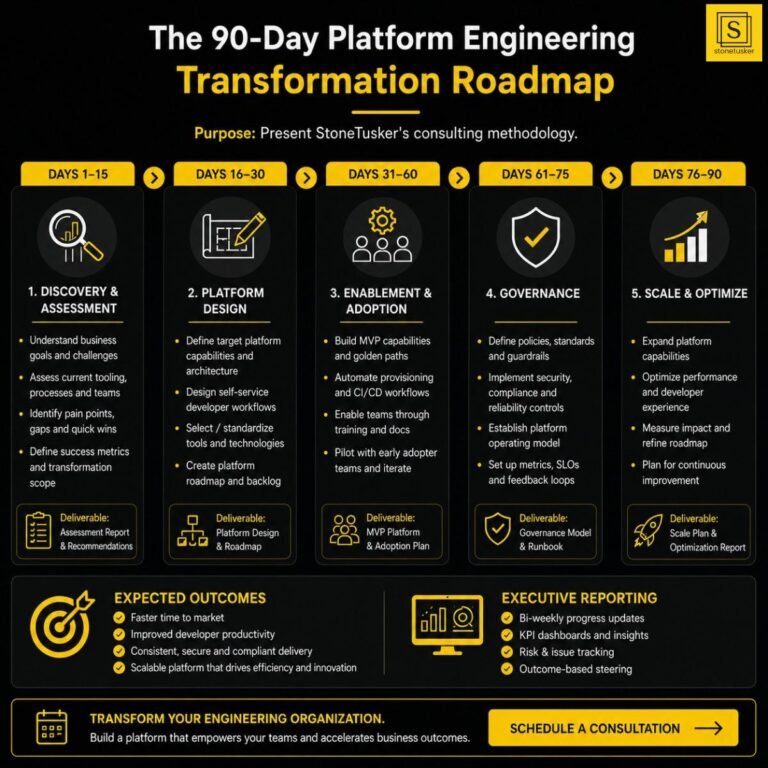
The 90-Day Platform Engineering Transformation Roadmap
You cannot buy your way out of slow delivery. Here is how to fix it in ninety days without freezing the work your teams are already doing.
Most organisations know software delivery has got more complicated over the last few years. Teams are expected to ship features fast while keeping security, compliance, reliability and operational resilience intact. On top of that, engineering leaders are under pressure to improve developer productivity without adding risk.
The usual reaction is to buy another tool. But tooling on its own rarely fixes delivery problems. Slow deployments, inconsistent environments, fragmented automation and fuzzy ownership almost always point to bigger platform engineering issues, not a missing piece of software.
A structured 90-day programme gives you a way to surface those issues, agree a practical roadmap and deliver measurable improvements, all without disrupting the engineering work already in flight.
This article walks through how a typical platform engineering transformation is structured, what your teams should expect in each phase, and how to reduce implementation risk while building a more reliable delivery platform.
Assess your platform engineering maturity
Before planning a transformation, it helps to know where your delivery sits today. The TuskerGauge assessment helps teams evaluate DevOps practices, platform maturity, CI/CD capabilities and operational readiness.
Why Platform Engineering Initiatives Often Struggle
Platform engineering gets misread as simply building an internal developer platform or adopting Kubernetes. In reality, the successful version is about improving the whole software delivery experience.
The problems teams run into tend to look like this:
- Developers spend too much time configuring environments instead of building software.
- Deployment pipelines differ from team to team, so operational practices are inconsistent.
- Infrastructure provisioning needs manual work and slows projects down.
- Security controls turn up late in the development lifecycle.
- Observability tooling exists, but nothing is standardised across services.
- Knowledge sits with a handful of senior engineers.
These rarely come from a single technology decision. They build up over years of incremental growth, shifting priorities and one-off optimisations.
A Practical 90-Day Approach
Instead of attempting a big platform redesign, most organisations get better results by focusing on incremental improvements over a defined window. A typical roadmap has four connected phases:
| Phase | Timeline | Focus |
|---|---|---|
| 1. Discovery and assessment | Weeks 1 to 3 | Understand how software gets delivered today. |
| 2. Platform design | Weeks 4 to 6 | Define a reference architecture and standards. |
| 3. Enablement and adoption | Weeks 7 to 10 | Get teams using the platform with less friction. |
| 4. Governance and continuous improvement | Weeks 11 to 12 and beyond | Keep the platform healthy, measured and owned. |
Each phase builds on the one before it while producing tangible outputs that leadership can review and prioritise.
Phase 1: Discovery and Assessment
The first phase is about understanding the current landscape, not rushing to propose technical fixes. Good initiatives start by gathering evidence across engineering workflows, infrastructure, developer experience and operational processes.
Technical assessment areas
- CI/CD pipeline maturity.
- Infrastructure automation.
- Cloud architecture.
- Kubernetes operations.
- Release engineering workflows.
- Developer onboarding.
- Security integration.
- Platform ownership.
- Observability implementation.
- Developer experience.
Stakeholder workshops
Technical assessments alone rarely expose the organisational bottlenecks. Conversations with engineering leaders, platform teams, developers, security specialists and operations engineers surface the friction that metrics cannot explain. Typical topics include current deployment frequency, incident response workflows, environment provisioning delays, release approval processes, compliance requirements and cross-team collaboration challenges.
Technical artefact review
Alongside the conversations, it helps to review the real artefacts: Infrastructure-as-Code repositories, Git branching strategies, pipeline definitions, Kubernetes manifests, monitoring dashboards, cloud account structures, architecture documentation and operational runbooks. The goal is not to hunt for isolated defects but to understand how teams actually deliver software today.
Current state assessment
The output of discovery is a documented view of your delivery capabilities, with the strengths, risks and opportunities laid out. Common findings include pipeline duplication across teams, inconsistent provisioning, manual deployment approvals, limited platform ownership, fragmented monitoring and security validation happening too late in the pipeline.
Phase 2: Platform Design
Once you understand the current state, attention shifts to designing a platform strategy that fits your business goals and stays realistic within your constraints. The emphasis is standardisation, not ripping out every existing technology.
Platform architecture principles
A modern strategy usually includes self-service developer capabilities, reusable infrastructure components, standard deployment pipelines, Infrastructure-as-Code, integrated security controls, observability by default and automated governance.
Reference architecture
The roadmap normally defines a reference architecture teams can adopt consistently across projects. It typically covers source control, build automation, container registries, Kubernetes platforms, secrets management, infrastructure provisioning, monitoring, logging and developer portals.
Technology selection
Platform design does not assume a single vendor ecosystem. Technology decisions should weigh existing investments, engineering capability, operational complexity, vendor support, security requirements and long-term maintainability. In a lot of engagements, the organisation already owns capable tooling. The harder challenge is establishing consistent practices and improving adoption, not swapping out technology.
Typical Outcomes Teams Measure After Implementation
- Engineering teams frequently reduce deployment inconsistencies after adopting standardised CI/CD templates.
- Platform teams commonly improve infrastructure consistency through Infrastructure-as-Code and reusable platform services.
- Development teams often spend less time troubleshooting environment differences once standard platform capabilities are in place.
- Engineering leadership gains better visibility into delivery performance through consolidated operational reporting.
Need a Technical Review?
If your teams are dealing with inconsistent deployments, growing platform complexity or developer productivity challenges, a structured technical discussion can identify practical improvements before any large-scale transformation begins.
Phase 3: Enablement and Adoption
A platform only delivers value when teams actually use it. Plenty of transformation programmes stall because they pour effort into architecture and neglect adoption. Platform engineering is as much an operational change initiative as it is a technical build.
In this phase, the focus moves from designing the platform to helping teams work well with it. The aim is to cut friction, improve developer experience and encourage consistent practices across teams.
Developer experience first
Developers should be able to provision environments, deploy applications, find documentation and troubleshoot issues without a chain of manual steps and approvals. A well-designed platform usually offers self-service project onboarding, standard CI/CD pipeline templates, automated infrastructure provisioning, integrated security scanning, centralised secrets management, built-in monitoring and logging, and reusable deployment workflows. The point is to remove repetitive work, not to add another layer of complexity.
Documentation and platform standards
Documentation is easy to underestimate. Platform capabilities need clear implementation guidance, architectural standards and operational runbooks behind them. That usually means architecture diagrams, repository standards, pipeline templates, provisioning guides, Kubernetes deployment standards, security policies, incident response procedures and clear ownership. Keep documentation close to the engineering workflow and it stays relevant as the platform changes.
Training and knowledge transfer
Long-term success comes from building internal capability, not creating a permanent dependency on outside consultants. Training often covers Infrastructure as Code, containerisation standards, Kubernetes operations, observability, CI/CD optimisation, security integration, release engineering and platform ownership. Hands-on workshops beat slide-based sessions every time, because engineers learn by working with the platform directly.
Phase 4: Governance and Continuous Improvement
Platform engineering is never a one-time project. Technology changes, teams evolve and priorities shift. Governance keeps the platform supporting your goals without turning into something nobody wants to maintain.
Platform ownership
Successful organisations define clear ownership across the platform lifecycle, covering roadmap management, technology lifecycle planning, security policy enforcement, infrastructure maintenance, developer support, operational reporting and documentation.
Engineering metrics
Track progress with operational indicators rather than assumptions. The usual set includes deployment frequency, lead time for changes, change failure rate, mean time to recovery, infrastructure provisioning time, developer onboarding duration and platform adoption rate. These show leadership where more work is needed while demonstrating the value the programme has delivered.
Security and compliance
Governance also folds security into everyday engineering work instead of treating compliance as a separate task. Typical controls include automated security scanning, infrastructure policy validation, secrets management standards, software supply chain verification, role-based access control, audit logging and compliance reporting.
What You Can Expect After 90 Days
Every organisation starts from a different level of maturity, so outcomes vary. Still, a structured programme usually delivers improvements across technology, engineering practices and operational visibility. By the end, engineering leaders generally have:
- A documented assessment of current platform maturity.
- A prioritised implementation roadmap.
- A reference platform architecture.
- Standardised CI/CD workflows.
- Infrastructure automation recommendations.
- Developer enablement guidance.
- A governance framework.
- Executive reporting aligned with engineering objectives.
Just as important, teams come away with a shared understanding of how platform engineering supports long-term delivery, rather than seeing it as yet another infrastructure initiative.
Planning a Platform Engineering Modernisation?
If you are weighing up DevOps, platform engineering or CI/CD modernisation, talking through your current delivery challenges with experienced practitioners can help prioritise improvements and reduce implementation risk.
Executive Reporting and the Long-Term Roadmap
The final deliverable is more than a technical report. It gives leadership a practical roadmap that lines platform investment up with business priorities. An executive report typically includes a summary of current maturity, key operational risks, priority improvement initiatives, recommended implementation phases, technology considerations, skills development recommendations, a governance framework and success metrics for ongoing measurement.
That roadmap lets you continue modernising beyond the initial engagement while keeping engineering teams, platform owners and business stakeholders aligned. A successful transformation does not end at day ninety. The engagement lays down the technical foundations, governance model and practices needed to keep improving over the months and years that follow.
Key Takeaways
- Slow delivery is usually a platform and ownership problem, not a missing tool.
- Incremental change over ninety days beats a risky big-bang platform rebuild.
- Discovery comes first: understand how teams deliver today before designing anything.
- Standardise rather than replace; most organisations already own capable tooling.
- Adoption is where programmes succeed or stall, so put developer experience first.
- Measure with operational metrics like deployment frequency, lead time and adoption.
- Treat the platform as an ongoing capability with clear ownership and governance.
Conclusion
Platform engineering is not about introducing another technology stack or replacing every tool you own. It is about building a consistent, secure and scalable delivery platform that lets teams ship software with less operational friction.
A structured 90-day programme gives you the chance to assess your current capabilities, find the operational bottlenecks and define a practical roadmap. Instead of chasing a large-scale redesign, teams can focus on incremental changes that improve developer experience, deployment reliability and governance.
Every organisation has different priorities, but the successful programmes tend to share the same traits. They start with a realistic assessment, establish clear ownership, standardise where it adds value and measure progress with meaningful metrics.
Most importantly, platform engineering should stay an ongoing capability, not a one-time project. Continuous improvement, regular governance reviews and steady investment in developer enablement keep the platform evolving alongside your technology and your business.
Frequently Asked Questions
1. What is a 90-day platform engineering transformation roadmap?
It is a structured engagement that assesses your current software delivery capabilities, designs an improved platform architecture, enables engineering teams through standardised practices and sets up governance for continuous improvement. The focus is on practical implementation priorities rather than large-scale technology replacement.
2. How is platform engineering different from DevOps?
DevOps is about collaboration, automation and continuous delivery across development and operations. Platform engineering builds on those principles by creating reusable internal platforms, standardised developer services and self-service capabilities that improve productivity while reducing operational complexity.
3. Does every organisation need an Internal Developer Platform?
Not necessarily. An Internal Developer Platform should solve genuine operational problems rather than become a technology project without clear goals. Some organisations do well with lightweight standardisation and automation, while others need a full platform to support many teams and complex environments.
4. How are transformation outcomes measured?
Teams commonly track deployment frequency, lead time for changes, change failure rate, mean time to recovery, platform adoption, infrastructure provisioning time and developer onboarding. These operational metrics give a clearer view of platform maturity than technology adoption alone.
5. What happens after the initial 90-day engagement?
The roadmap becomes the implementation plan. Follow-on work often includes platform implementation, Infrastructure as Code adoption, Kubernetes modernisation, CI/CD optimisation, DevSecOps integration, observability improvements and developer enablement, based on your priorities.
About the Author
Subeesh Sivanandan is Founder and CEO of Stonetusker Systems, with 26 years of experience across DevOps, CI/CD, Platform Engineering, Release Engineering, Infrastructure Automation and engineering transformation programmes.
He has worked with organisations including Stryker, Nokia, IP Infusion, VeriSign and CMC Ltd, helping engineering teams modernise delivery platforms, improve deployment reliability and standardise engineering practices across enterprise environments.