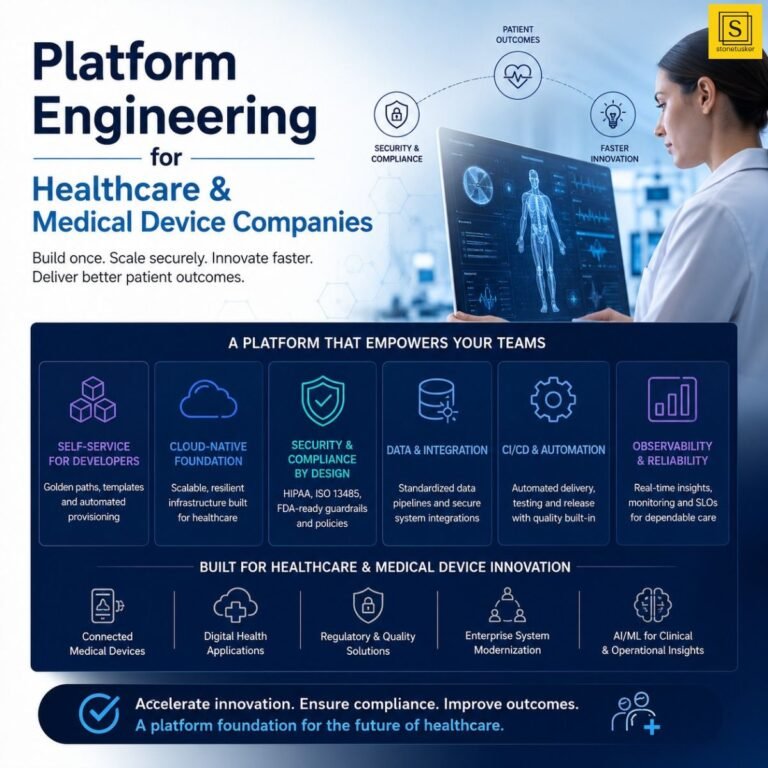
Platform Engineering for Healthcare and Medical Device Companies
In regulated healthcare, speed and compliance usually get treated as enemies. A well-built internal platform makes them the same thing.
Healthcare and medical device organisations are under real pressure to ship software faster while meeting some of the strictest regulatory requirements around. Connected medical devices, digital health platforms, Software as a Medical Device (SaMD), cloud-native healthcare applications and AI-powered clinical tools have all pushed software complexity up sharply. At the same time, regulators expect full traceability, strong security controls, validated processes and effective risk management across the entire software lifecycle.
Plenty of teams have adopted DevOps to move faster. That usually helps collaboration and automation, but it can also create inconsistency when every product team builds and runs its own CI/CD pipelines, cloud infrastructure, Kubernetes clusters, security tooling and deployment workflows. Over time, those differences pile up: more operational overhead, harder compliance, and audits that turn into a scramble.
Platform engineering tackles this by creating a standardised internal developer platform that offers reusable engineering capabilities through self-service. Instead of every team solving the same infrastructure and delivery problems on its own, a dedicated platform team builds shared services with security, governance, automation and operational best practice baked in. Developers get to focus on building healthcare applications while the platform keeps engineering environments consistent.
For regulated industries, platform engineering is more than an infrastructure project. It is a practical way to standardise delivery while supporting frameworks like IEC 62304, ISO 13485, FDA 21 CFR Part 11, FDA 21 CFR Part 820, HIPAA, GDPR and ISO 27001 where they apply. Rather than treating compliance as a separate task performed just before release, teams embed the controls directly into daily workflows.
It also improves collaboration between engineering, security, quality assurance, regulatory affairs and operations. Instead of working in isolated processes, these groups share common delivery platforms, automated validation pipelines and centralised visibility. Communication gaps shrink and delivery becomes far more predictable.
And it scales. As you expand product portfolios or bring on new teams, you no longer rebuild infrastructure, pipelines and monitoring for every project. New teams adopt approved templates and platform services from day one, which cuts onboarding time while holding the line on standards.
Why Platform Engineering Matters in Healthcare
Healthcare software touches patient care, clinical operations and business continuity directly. A failure can delay treatment, interrupt hospital services, expose sensitive patient data or introduce risk into connected devices. So engineering leaders need delivery processes that balance innovation with operational stability.
Traditional infrastructure models make developers spend a lot of time configuring environments, maintaining deployment scripts, chasing infrastructure issues and coordinating manual approvals. That is all time not spent on product features and clinical functionality.
A platform engineering approach lifts most of that operational weight by providing reusable building blocks teams consume on demand. Standard CI/CD pipelines, Infrastructure as Code templates, Kubernetes platforms, observability, identity management, secrets management and security controls become centrally managed capabilities instead of project-specific one-offs.
That lets teams deliver more consistently without giving up governance. Compliance requirements sit inside automated workflows rather than adding another round of manual review. The result is a delivery platform that supports both productivity and regulatory confidence.
Measure your engineering delivery maturity
Before investing in platform engineering, it helps to understand how mature your current delivery really is. Assess your DevOps, CI/CD, DevSecOps, infrastructure automation and engineering practices with TuskerGauge.
Compliance Challenges in Healthcare and Medical Device Software
Building software for healthcare and medical device organisations takes more than writing reliable code. Teams have to show that every change was planned, reviewed, tested, approved, deployed and documented according to established quality and regulatory processes. As you grow, keeping that consistent across many teams gets steadily harder.
A lot of organisations still lean on manual approvals, fragmented toolchains and team-specific processes. That can work on smaller projects, but it becomes a bottleneck as the portfolio expands. Platform engineering helps by standardising workflows and embedding governance into the platform itself.
Maintaining end-to-end traceability
Regulated development demands full traceability across the lifecycle. You need to show how business requirements connect to design decisions, source code, automated tests, security reviews, validation activities and production releases. During an audit, that should be ready to hand, not reconstructed from a dozen systems. Without a common platform, traceability ends up scattered across issue trackers, repos, CI/CD tools, document management systems, spreadsheets and email approvals. Pulling evidence from all of those burns engineering time and risks missing records. A platform engineering approach folds these activities into one delivery workflow, so every commit, build, deployment, approval and test run adds to a continuous audit trail that maintains itself.
Managing infrastructure consistency
Healthcare applications usually run across development, testing, validation, staging and production. Differences between those environments cause deployment failures, odd behaviour and long troubleshooting sessions. Infrastructure as Code lets you define infrastructure in version-controlled templates that reproduce consistently everywhere. Paired with platform engineering, those templates become reusable services that simplify provisioning while keeping governance tight and drift low.
Strengthening security across the pipeline
Healthcare organisations handle highly sensitive patient information and increasingly run connected devices talking across clinical networks and cloud platforms. Security has to be part of every stage of delivery, not a check performed only before release. A mature platform builds automated security controls into the workflow. Static code analysis, dependency scanning, container image validation, Infrastructure as Code scanning, secret detection and policy enforcement become standard pipeline steps rather than optional extras. That lowers the chance of shipping a vulnerability and gives you consistent evidence for compliance reviews.
Secure CI/CD for Regulated Healthcare Environments
Continuous Integration and Continuous Delivery are now table stakes for modern engineering. But healthcare organisations need pipelines that do more than automate delivery. They also have to enforce governance, maintain traceability and support compliance. Platform engineering provides standard pipeline templates every product team can adopt, so developers inherit proven workflows instead of building pipelines from scratch.
Standardised pipeline templates
Reusable CI/CD templates improve consistency across teams. Every application follows a similar delivery process while still leaving room for product-specific needs. That reduces complexity, simplifies platform support and applies engineering standards consistently.
Automated quality gates
Each change should pass predefined validation stages before moving to the next environment. Typical gates include source compilation, unit testing, integration testing, static application security testing, software composition analysis, Infrastructure as Code validation, container image scanning and policy compliance checks. Automating these cuts manual effort while raising confidence in every release.
Evidence generation by default
One of the biggest wins is that compliance evidence gets generated automatically during delivery. Build logs, deployment records, approval histories, vulnerability reports, software versions and test results all become permanent artefacts of the release. Nobody has to collect this by hand before an audit, because it already lives in the platform.
Audit Readiness Through Platform Engineering
Audit preparation is one of the most resource-heavy activities for regulated teams. Whether it is an FDA inspection, an ISO certification audit, a customer assessment or an internal quality review, organisations often spend weeks gathering deployment records, test reports, change requests, approval histories and infrastructure documentation. That pulls engineers off delivery and raises the risk of incomplete or inconsistent evidence.
Platform engineering flips this by making audit readiness a continuous capability rather than a periodic scramble. Instead of generating evidence at the end of a release cycle, the platform captures and stores it automatically as software moves through the pipeline. Every build, deployment, infrastructure change, security scan, approval and test run adds to a complete, searchable audit trail.
Continuous compliance instead of manual documentation
Traditional compliance work leans on spreadsheets, hand-maintained records and document repositories that need constant updating. That does not scale as teams grow and release more often. An internal developer platform connects the engineering tools so compliance information is recorded automatically. Source repos, CI/CD platforms, Infrastructure as Code, testing frameworks, security tools and deployment systems work together to produce reliable evidence without extra admin from developers, which improves both efficiency and confidence during reviews.
Improving change management
Every release should have a clear history: what changed, why, who approved it, how it was tested and when it shipped. Platform engineering standardises change management across projects by folding approval gates, version control, deployment records and release documentation into one process. When auditors ask for evidence, teams retrieve full deployment histories without hunting across disconnected systems.
Supporting risk-based validation
Not every change carries the same risk. A mature platform lets you apply different validation and approval workflows based on how critical the application is, which environment it targets or its regulatory classification. Low-risk changes flow efficiently through automated pipelines, while higher-risk releases pick up extra reviews, testing or approvals. That balance keeps you compliant without needlessly slowing delivery.
Developer Productivity Without Compromising Governance
A common myth about regulated development is that stronger governance always means slower developers. In reality, developers slow down when they are stuck maintaining infrastructure, fighting inconsistent environments or navigating clunky manual processes. Platform engineering removes much of that burden with reusable services developers reach through self-service.
Instead of configuring Kubernetes clusters, pipelines, monitoring or cloud infrastructure for every new project, teams consume approved platform capabilities the platform team has already validated.
Reducing cognitive load
Modern delivery asks for knowledge of cloud platforms, networking, containers, Infrastructure as Code, security controls, Kubernetes, observability and deployment automation. Expecting every application developer to master all of it drives up cognitive load and slows product work. Platform engineering hides that complexity behind reusable services, so developers focus on building healthcare applications while platform specialists maintain the shared foundations.
Accelerating onboarding
New teams get productive far faster when environments, pipelines, security controls and infrastructure templates already exist. Rather than building foundations from scratch, new projects start from proven platform components that match organisational standards, which improves collaboration and cuts operational support.
Planning Your Platform Engineering Journey?
If your teams are hitting deployment bottlenecks, fragmented CI/CD pipelines or rising compliance overhead, it may be time to look at a platform-first approach. A structured assessment can find opportunities to standardise delivery, strengthen governance and improve productivity without disrupting existing product work.
A Reference Architecture for Healthcare Platform Engineering
Every healthcare organisation has its own regulatory and operational needs, but successful platform engineering implementations tend to follow a layered architecture. It separates application development from platform operations while giving every team standard services they can consume securely and consistently.
The goal is not to box developers in. It is to provide a reliable engineering foundation that reduces duplication, improves governance and speeds up delivery. With reusable capabilities available, teams spend less time building infrastructure and more time delivering product.
Core components of the platform
- Source code management with version control, branch protection, pull request reviews and full change history.
- CI/CD platforms that automate builds, testing, security validation, approvals, deployments and release documentation.
- Infrastructure as Code repositories that provision cloud resources, Kubernetes clusters, networking and environments from version-controlled templates.
- Identity and access management enforcing role-based access, least privilege and secure authentication across systems.
- Container registries that store images securely while scanning for vulnerabilities and signing images before deployment.
- Observability platforms that centralise logs, metrics, distributed tracing, dashboards and alerting.
- Secrets management for credentials, API keys, certificates, encryption keys and other sensitive configuration.
- Compliance reporting that consolidates deployment evidence, approval history, security reports, software versions and audit artefacts into one view.
Key design principles
A good internal developer platform offers opinionated defaults while staying flexible enough for different teams and application architectures. Standardisation should make engineering simpler, not stifle innovation. Reusable templates, automated governance, self-service provisioning, integrated observability and policy-driven deployments let teams deliver more consistently without piling on complexity. Most importantly, the platform should keep evolving. As new regulations, security practices, cloud services and tools appear, it should adapt without disrupting the teams that depend on it every day.
Implementation Considerations
Implementing platform engineering takes more than picking new tools. Treat it as an engineering transformation involving people, processes, governance and technology. The most successful efforts start from clear business objectives, not infrastructure modernisation for its own sake.
Start with your existing challenges
Before designing a platform, assess your current delivery. Signs that platform engineering can help include inconsistent pipelines, slow environment provisioning, duplicated infrastructure, fragmented security tooling, manual compliance work and rising operational overhead. Understanding these helps you prioritise capabilities that deliver measurable improvement without large-scale disruption.
Adopt incrementally
Trying to replace every process at once just adds risk. Deliver the platform in manageable phases instead. Standardising CI/CD, Infrastructure as Code, observability and identity management often pays off immediately while laying a foundation for more. As teams gain confidence, add self-service infrastructure, policy automation, software supply chain security and developer portals over time.
An Illustrative Case Study
The client’s name is not disclosed due to an NDA.
A healthcare AI company developing oncology and radiology software had separate delivery processes for its clinical application, backend services, medical imaging pipelines and AI models. Each team managed its own pipelines, infrastructure, monitoring and release evidence. The approach worked at first, but differences between development, validation and production made releases and compliance reviews harder as the platform grew.One of the major achivement was HIPAA and GDPR as this company was based on US and serving for US and EU hospitals
A small platform engineering team introduced reusable CI/CD templates, Infrastructure as Code modules, microservices standards, integrated security checks and central observability. Teams moved gradually while keeping ownership of their applications and models.
The shared platform improved environment consistency, automated release evidence and made it easier to trace each deployment back to its code, model version, tests and approvals. It did not replace clinical validation or compliance work, but it gave development, AI, quality, security and operations teams a more reliable foundation.
Typical Outcomes Teams Measure After Adoption
- More consistent development, validation and production environments.
- Faster release documentation through automated evidence collection.
- Clear traceability across application and AI model releases.
- Less time spent on environment-specific troubleshooting.
- Quicker onboarding using approved platform components.
Conclusion
Healthcare and medical device organisations face growing pressure to deliver software faster while holding high standards for quality, security and compliance. As teams grow and software ecosystems get more complex, traditional infrastructure and delivery approaches get hard to scale. Multiple pipelines, inconsistent environments, fragmented security controls and manual compliance all add risk and slow developers down.
Platform engineering offers a structured way through, with a standardised internal developer platform that combines infrastructure automation, secure CI/CD, observability, governance and self-service. Rather than asking every team to build and maintain its own foundations, you create a shared platform that bakes operational best practice into everyday delivery.
For regulated industries, the benefits go beyond efficiency. Automated audit trails, consistent deployments, Infrastructure as Code, integrated security and standard workflows simplify compliance while lowering overhead. Teams get to spend more time building healthcare applications and less time maintaining delivery plumbing.
Platform engineering is not just a technology project. It is a shift in how engineering organisations deliver software, and it depends on collaboration between platform engineers, developers, security, quality assurance, regulatory specialists and leadership. Organisations that invest in shared engineering capabilities are far better placed to scale product development while keeping the governance regulated healthcare demands.
Build a Secure Platform Engineering Foundation
If you are modernising software delivery, strengthening DevSecOps or building an internal developer platform for regulated healthcare, Stonetusker Systems can help you design a platform that balances developer experience, operational reliability and compliance.
Key Takeaways
- In regulated healthcare, a good platform makes speed and compliance work together instead of against each other.
- Compliance evidence should be generated automatically by the platform, not gathered by hand before an audit.
- Standard CI/CD templates, Infrastructure as Code and integrated security controls remove the inconsistency that makes audits painful.
- Audit readiness becomes a continuous capability rather than a periodic scramble.
- Stronger governance does not have to slow developers; removing operational toil actually speeds them up.
- Start from real engineering challenges and adopt the platform incrementally to reduce risk.
- Treat platform engineering as a transformation across people, process and technology, not just a tooling change.
Frequently Asked Questions
1. What is platform engineering in healthcare?
Platform engineering is the practice of building an internal developer platform that provides reusable infrastructure, CI/CD pipelines, security controls, observability and deployment automation as shared services. In healthcare organisations it helps engineering teams deliver software more consistently while supporting regulatory compliance and reducing operational overhead.
2. How does platform engineering support medical device software compliance?
It embeds governance into software delivery by automating evidence collection, standardising deployment workflows, maintaining traceability, integrating security validation and enforcing engineering policies consistently across projects. That simplifies compliance work while improving software quality and release confidence.
3. Is platform engineering different from DevOps?
Yes. DevOps focuses on collaboration, automation and continuous delivery. Platform engineering extends those principles by creating reusable internal platforms that provide standard engineering capabilities for many development teams, reducing duplication while improving developer experience and consistency.
4. Can platform engineering improve developer productivity?
Yes. Developers spend less time maintaining infrastructure, configuring pipelines, troubleshooting environments and managing tooling. Self-service platform capabilities let teams focus on delivering application features while the platform team manages shared infrastructure and governance.
5. Which healthcare organisations benefit most from platform engineering?
Medical device manufacturers, healthcare SaaS providers, digital health companies, diagnostic solution providers, pharmaceutical technology organisations, hospital software vendors and Software as a Medical Device (SaMD) developers all benefit through improved consistency, security, scalability and compliance.
About the Author
Subeesh Sivanandan is Founder and CEO of Stonetusker Systems, with over 26 years of experience in DevOps, Platform Engineering, CI/CD, Release Engineering, Infrastructure Automation, Kubernetes, Embedded Linux and engineering transformation. He has helped organisations modernise engineering practices across healthcare, medical devices, networking, telecommunications and enterprise software.
Having worked with organisations including Stryker, Nokia, IP Infusion, VeriSign and CMC Ltd, he brings practical implementation experience in designing scalable engineering platforms that improve software delivery, security and operational reliability within regulated industries.