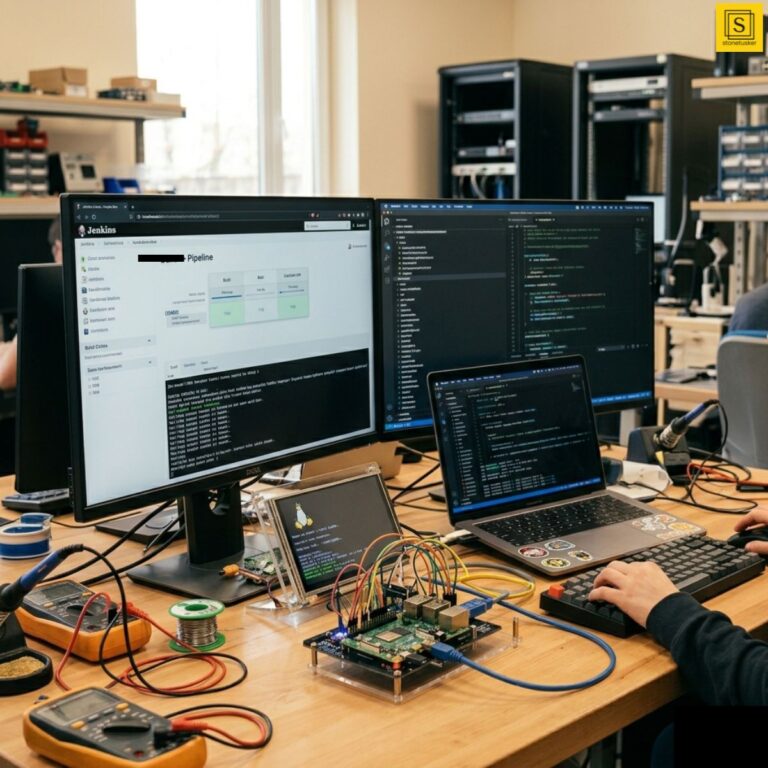
Embedded Linux DevOps vs Cloud DevOps: Why Most Teams Are Still Years Behind
Cloud-native engineering teams have spent the last decade refining deployment automation, platform engineering, infrastructure-as-code, and CI/CD practices. In many organisations, production deployments happen multiple times a day with predictable release processes, automated testing, and rapid recovery mechanisms.
Embedded Linux engineering has not progressed at the same pace.
Many teams still accept four to eight-hour Yocto builds as normal. Firmware validation frequently waits for image creation. Security certification activities often begin months later than they should. Compliance evidence is assembled manually when audit deadlines appear.
The consequences are significant. Hardware teams sit idle waiting for firmware validation. Product release schedules slip. Security reviews become painful. Engineering organisations spend more time managing delivery friction than delivering product value.
This article explores why Embedded Linux DevOps continues to lag behind cloud DevOps, the operational consequences of that gap, and the engineering practices high-performing teams use to modernise embedded software delivery.
What Is Embedded Linux DevOps?
Embedded Linux DevOps is the application of CI/CD, release engineering, platform engineering, DevSecOps, automation, and software supply chain management practices to embedded devices, firmware platforms, and Linux-based operating systems throughout the product lifecycle.
Unlike cloud DevOps, Embedded Linux DevOps must account for hardware dependencies, cross-compilation toolchains, constrained devices, OTA update reliability, manufacturing processes, regulatory requirements, and long-term product support obligations.
Measure Your Delivery Maturity Before Modernisation
Many engineering teams know they have delivery bottlenecks but struggle to identify which problems create the most operational drag. Evaluate your current DevOps, release engineering, platform engineering, and compliance maturity using TuskerGauge.
Why Does Embedded Linux DevOps Still Lag Behind Cloud DevOps?
Embedded Linux DevOps lags behind cloud DevOps because embedded delivery systems must manage hardware constraints, complex toolchains, certification requirements, device lifecycle management, and deployment risks that cloud platforms rarely encounter.
However, technical complexity alone does not explain the gap.
Many organisations continue operating delivery systems that have received little investment compared to application development initiatives. Build engineering, release automation, compliance tooling, and platform engineering are frequently treated as operational overhead rather than strategic capabilities.
As a result, engineering teams often struggle with predictable delivery challenges that cloud-native organisations solved years ago.
Embedded Linux DevOps vs Cloud DevOps
The differences between cloud and embedded delivery environments become clear when comparing their operational realities.
| Capability | Cloud DevOps | Embedded Linux DevOps |
|---|---|---|
| Build Duration | Typically minutes | Often several hours |
| Rollback Complexity | Usually straightforward | Can require device recovery mechanisms |
| Deployment Target | Virtual infrastructure | Physical devices and hardware |
| Security Requirements | Application-focused | Hardware, OS and supply-chain focused |
| Compliance Requirements | Varies by industry | Often mandatory in regulated sectors |
| Recovery Strategy | Service restart or redeployment | A/B partitions, recovery images, field support |
| Product Lifecycle | Months to years | Often 5–15 years |
The engineering challenge is not simply deploying software. It is delivering software reliably into environments where failures can disable physical products, disrupt operations, or trigger regulatory consequences.
The Four Embedded Linux Delivery Failure Modes
Across embedded Linux programmes, four recurring delivery bottlenecks appear repeatedly regardless of industry.
- Build Bottlenecks that slow validation and release cycles.
- OTA Fragility that increases field deployment risk.
- Certification Debt that delays regulatory readiness.
- Compliance Drift that weakens traceability and auditability.
Most organisations experience some combination of all four. The difference between high-performing and low-performing engineering teams is not whether these challenges exist, but whether they are addressed systematically.
Why Are Yocto Builds Still Taking Four to Eight Hours?
Long Yocto build times remain one of the most expensive forms of hidden engineering waste in embedded development.
When a full image build requires four to eight hours, the impact extends far beyond developer inconvenience. Hardware validation schedules slow down. Integration testing waits for firmware availability. Release candidates take longer to verify. Engineering feedback loops become painfully slow.
One recurring pattern we encounter is teams investing heavily in hardware validation labs while continuing to run Yocto builds on underpowered virtual infrastructure. The result is a highly optimised testing environment attached to a poorly optimised delivery pipeline.
According to the 2024 Google Cloud DORA Report, high-performing software delivery teams consistently outperform low-performing teams across deployment frequency, lead time, and recovery performance. While the report primarily examines software delivery organisations, the underlying lesson applies equally to embedded environments: engineering throughput improves when feedback cycles become shorter.
What Causes Slow Yocto Builds?
- Build infrastructure is frequently under-provisioned for the workload.
- Shared-state caching is absent or poorly configured.
- Build artefacts are regenerated unnecessarily.
- Layer structures reduce cache effectiveness.
- Build workloads are not distributed efficiently.
- Build reproducibility requirements increase processing overhead.
What High-Performing Teams Do Differently
Engineering teams that successfully reduce build times typically approach build engineering as a platform capability rather than a developer responsibility.
- They implement aggressive sstate-cache strategies.
- They deploy dedicated build farms.
- They optimise Yocto layer architecture.
- They standardise build environments.
- They automate dependency management.
- They continuously measure build performance.
In production environments, we have seen organisations reduce multi-hour build workflows to well under an hour after introducing shared-state caching, build farm optimisation, and disciplined layer management practices. The exact outcome depends on image complexity, infrastructure design, and dependency structure, but the principle remains consistent.
The important lesson is that build performance should be treated as a delivery systems problem rather than a developer productivity problem.
Discuss Your Build Bottlenecks with an Engineer
If Yocto build times, release engineering workflows, or platform automation challenges are slowing delivery, discuss the constraints with an engineer at Stonetusker Systems. Many bottlenecks become easier to solve once the delivery system is examined end-to-end.
Why OTA Updates Are Really a Release Engineering Problem
Most embedded teams approach Over-the-Air updates as a deployment problem. In reality, OTA success is primarily determined by release engineering decisions made long before a device ever reaches a customer environment.
The deployment mechanism matters, but deployment tooling cannot compensate for poor rollback design, weak recovery strategies, or inadequate validation workflows.
When a cloud deployment fails, teams can often redeploy within minutes. When a firmware update fails on a deployed device, recovery may require physical intervention, customer support involvement, or complete device replacement.
That difference fundamentally changes how deployment systems should be designed.
What Makes OTA Updates Difficult?
- Devices may operate in remote or inaccessible locations.
- Network connectivity may be intermittent.
- Storage and memory resources are constrained.
- Field failures can impact customer operations.
- Recovery mechanisms must function without human intervention.
- Product lifecycles often span many years.
The challenge is not pushing software to devices. The challenge is ensuring that every failed deployment has a predictable recovery path.
What Should Be Designed Before OTA Deployment Begins?
Several critical decisions must be made during platform architecture and release engineering design.
- Rollback strategy.
- Partition architecture.
- Update validation workflow.
- Recovery mechanisms.
- Deployment approval policies.
- Field observability requirements.
Teams that postpone these decisions often find themselves making them during production incidents, which is the most expensive time to discover architectural weaknesses.
Why A/B Partitioning Remains the Preferred OTA Strategy
A/B partitioning remains one of the most reliable approaches for reducing firmware deployment risk in embedded Linux environments.
Under this model, devices maintain two bootable images. Updates are deployed to the inactive partition while the active image continues serving as a known-good recovery point.
If validation succeeds after reboot, the new image becomes active. If validation fails, the device automatically reverts to the previous version.
This architecture significantly reduces the probability of permanently disabling a device after a failed update.
| OTA Approach | Advantages | Trade-Offs |
|---|---|---|
| A/B Partitioning | Reliable rollback and recovery | Requires additional storage |
| Single Partition Updates | Lower storage requirements | Higher deployment risk |
| Delta Updates | Reduced bandwidth usage | Increased complexity |
| Container-Based Updates | Application isolation | Additional runtime overhead |
For most regulated or mission-critical environments, the storage cost of A/B partitioning is usually justified by the operational risk reduction it provides.
Why Security Certification Must Be Designed Into the Pipeline
Many engineering teams still approach security certification as an activity performed near the end of product development.
That approach rarely works well.
Security certification requirements often influence platform architecture, build processes, cryptographic implementation choices, software supply chain controls, and operating system hardening decisions.
By the time a certification audit begins, many of the most important engineering decisions have already been made.
If those decisions were made without certification requirements in mind, remediation can become expensive and time-consuming.
Which Security Programmes Commonly Affect Embedded Linux Products?
- FIPS 140-3 cryptographic validation.
- Common Criteria evaluations.
- IEC 62443 industrial cybersecurity requirements.
- ISO 21434 automotive cybersecurity requirements.
- NIST Secure Software Development Framework recommendations.
- Sector-specific government and defence requirements.
Each framework introduces different requirements, but they share a common expectation: security controls must be implemented consistently and verified repeatedly.
What Is FIPS 140-3 and Why Does It Matter?
FIPS 140-3 is a United States government standard used to validate cryptographic modules and their implementation. Organisations selling products into government, defence, healthcare, and regulated sectors frequently encounter FIPS requirements.
Many teams underestimate the engineering effort involved.
FIPS readiness is not simply a matter of enabling a configuration flag in OpenSSL. The certification process involves cryptographic implementation controls, operational procedures, documentation requirements, and validation activities that must be maintained throughout the software lifecycle.
Attempting to retrofit these controls shortly before certification audits typically creates substantial rework.
How DevSecOps Simplifies Certification Readiness
DevSecOps practices help organisations integrate security controls directly into delivery workflows.
- Build pipelines verify approved configurations.
- Hardening policies are enforced automatically.
- Security scanning runs continuously.
- Software composition analysis identifies vulnerable dependencies.
- Policy violations prevent unauthorised releases.
- Audit evidence is generated automatically.
This approach transforms security from a periodic project into a repeatable engineering capability.
Typical Outcomes Teams Observe After Security Automation
- Engineering teams spend less time preparing for certification reviews because evidence collection becomes automated.
- Security vulnerabilities are identified earlier in the development lifecycle.
- Release approval processes become more predictable and auditable.
- Compliance and security teams gain greater confidence in software provenance.
Planning for Security Certification or Compliance?
Many certification programmes fail because delivery systems were never designed to generate the evidence auditors require. If you are preparing for FIPS 140-3, Common Criteria, IEC 62443, or ISO 21434 initiatives, discuss the delivery architecture challenges with an engineer at Stonetusker Systems.
Why Software Supply Chain Security Is Becoming a Board-Level Concern
Software supply chain security has become a strategic concern across government, healthcare, industrial automation, automotive, and critical infrastructure sectors.
High-profile software supply chain incidents have demonstrated that vulnerabilities can originate from dependencies, build environments, third-party components, and development workflows.
As a result, organisations increasingly expect visibility into how software is built, what components are included, and whether dependencies can be traced throughout the delivery lifecycle.
For embedded Linux teams, this means software provenance is no longer optional. It is becoming a fundamental requirement for customer trust, regulatory readiness, and long-term product support.
Why Compliance Is No Longer Separate From Engineering
Many organisations still treat compliance as a documentation exercise performed after development is complete. That approach becomes increasingly difficult to sustain as regulatory requirements become more software-centric and supply-chain focused.
Modern compliance frameworks expect traceability, reproducibility, security controls, change management evidence, and software provenance throughout the product lifecycle.
In practical terms, this means your CI/CD pipeline increasingly becomes your compliance engine.
The organisations that perform best during audits are rarely the organisations that create the most documentation. They are usually the organisations that generate compliance evidence continuously as part of normal engineering workflows.
How Compliance Requirements Affect Embedded Linux Delivery
Although standards vary across industries, most frameworks require evidence that software was developed, tested, secured, approved, and released through controlled processes.
| Standard | Primary Focus | Delivery System Impact |
|---|---|---|
| ISO 21434 | Automotive cybersecurity | Security traceability and risk management |
| IEC 62304 | Medical device software lifecycle | Documentation and validation controls |
| IEC 62443 | Industrial cybersecurity | Secure development and deployment controls |
| NIST SSDF | Secure software development | Secure coding and supply-chain governance |
These standards differ in scope, but they all place increasing pressure on engineering teams to provide reliable evidence rather than manually assembled documentation.
Why Build Reproducibility Matters More Than Most Teams Realise
Build reproducibility is often discussed during compliance reviews, but many organisations do not fully appreciate its operational importance until they encounter a security incident, audit finding, or customer investigation.
A reproducible build allows engineering teams to recreate an identical software image using the same source code, dependencies, build configuration, and tooling.
Without reproducibility, several problems emerge.
- Security investigations become slower.
- Certification evidence becomes harder to defend.
- Root cause analysis takes longer.
- Supply-chain verification becomes more difficult.
- Customer support escalations become harder to resolve.
One recurring issue in embedded Linux programmes is the gradual accumulation of undocumented build dependencies. Teams often discover years later that recreating a historical release requires access to repositories, toolchains, or configuration files that no longer exist.
By that stage, remediation becomes significantly more expensive.
What Reproducible Build Pipelines Require
- Version-controlled build configurations.
- Immutable release artefacts.
- Controlled dependency management.
- Consistent build environments.
- Cryptographically verifiable artefacts.
- Automated audit trails.
These controls improve both compliance readiness and operational resilience.
Why SBOM Generation Must Be Automated
A Software Bill of Materials (SBOM) is a machine-readable inventory of software components, dependencies, libraries, and packages included within a software product.
SBOMs have become a central requirement in software supply-chain security programmes because they provide visibility into what is actually running inside a device.
When a vulnerability is disclosed, organisations with accurate SBOMs can quickly determine whether affected components exist within deployed products.
Organisations without SBOM visibility often spend days or weeks manually investigating dependencies.
How Yocto Supports SBOM Generation
The Yocto Project provides support for Software Bill of Materials generation through the create-spdx functionality.
This capability enables engineering teams to generate SPDX-compliant SBOMs as part of the build process, improving software inventory visibility and audit readiness.
The technology itself is rarely the challenge.
The challenge is ensuring SBOM generation becomes part of every build rather than a periodic compliance activity.
When SBOM generation is integrated into CI/CD pipelines, organisations gain:
- Improved vulnerability response capability.
- Better software provenance visibility.
- Stronger compliance evidence.
- Faster customer security reviews.
- Improved audit readiness.
How Platform Engineering Changes Embedded Linux Delivery
One of the most important lessons cloud engineering teams learned over the past decade is that developer productivity improves when common capabilities are delivered through internal platforms.
The same principle applies to embedded Linux environments.
Many organisations still operate with separate teams maintaining build systems, release tooling, security controls, compliance workflows, and deployment infrastructure independently.
This often creates duplicated effort, inconsistent processes, and fragmented tooling.
Platform engineering provides a different model.
What an Embedded Linux Platform Typically Provides
- Standardised Yocto build environments.
- Shared CI/CD pipelines.
- Centralised release engineering workflows.
- Integrated security controls.
- Automated compliance evidence collection.
- SBOM generation and management.
- OTA deployment governance.
- Observability and delivery metrics.
Rather than forcing every product team to solve the same operational problems repeatedly, platform teams provide reusable capabilities that accelerate delivery while improving consistency.
When Does Platform Engineering Make Sense for Embedded Teams?
Platform engineering becomes increasingly valuable when organisations support multiple products, multiple hardware platforms, multiple engineering teams, or multiple compliance requirements.
If teams regularly rebuild delivery tooling for each project, the organisation is usually paying an unnecessary operational tax.
A useful rule of thumb is simple.
If three teams are solving the same delivery problem independently, the solution probably belongs on a platform.
Typical Outcomes Teams Measure After Modernising Embedded Linux Delivery
- Engineering teams commonly reduce build wait times after implementing shared-state caching and build farm optimisation.
- Release engineering groups often improve deployment reliability after introducing structured OTA recovery mechanisms and A/B partition strategies.
- Security teams usually gain faster visibility into software vulnerabilities after integrating automated SBOM generation into build pipelines.
- Compliance programmes frequently become easier to manage when audit evidence is generated automatically through CI/CD workflows.
- Platform teams often improve consistency across products by standardising build environments, release processes, and security controls.
Frequently Asked Questions
What is Embedded Linux DevOps?
Embedded Linux DevOps is the application of CI/CD, release engineering, DevSecOps, platform engineering, and automation practices to embedded devices and Linux-based operating systems. The goal is to improve delivery speed, deployment reliability, security, compliance readiness, and operational efficiency throughout the product lifecycle.
Why are Yocto builds often so slow?
Yocto builds perform dependency resolution, package compilation, image generation, and validation across a large number of software components. Without shared-state caching, distributed build infrastructure, and efficient layer management, build durations can easily extend into several hours.
What is the biggest mistake organisations make with OTA updates?
Many teams focus on deployment tooling while overlooking release engineering design decisions. Rollback architecture, partitioning strategy, validation workflows, and recovery mechanisms should be defined before devices are deployed into production environments.
Why are SBOMs becoming mandatory in many industries?
Software supply-chain security requirements continue to increase across regulated sectors. SBOMs provide visibility into software components and dependencies, helping organisations respond more quickly to vulnerabilities, customer security reviews, and compliance audits.
How does DevSecOps help with security certifications?
DevSecOps integrates security controls directly into delivery pipelines. Automated hardening checks, vulnerability scanning, policy enforcement, and evidence generation help organisations maintain certification readiness continuously rather than preparing manually before audits.
What is build reproducibility?
Build reproducibility is the ability to generate identical software artefacts from the same source code and build configuration. It supports auditability, software provenance, security investigations, and long-term maintenance of embedded products.
When should SBOM generation be introduced?
SBOM generation should be introduced as early as possible in the development lifecycle. Retrofitting software inventory processes after products reach production is significantly more difficult and often creates unnecessary compliance risk.
What industries benefit most from Embedded Linux DevOps?
Embedded Linux DevOps is particularly valuable in automotive, healthcare, industrial automation, telecommunications, defence, aerospace, and critical infrastructure environments where security, compliance, reliability, and long-term support are important requirements.
How do I know if our delivery system needs modernisation?
Long build times, inconsistent releases, manual compliance processes, weak software traceability, deployment failures, and certification delays are all indicators that delivery workflows may require modernisation.
What is the first step in modernising an Embedded Linux delivery pipeline?
The first step is understanding where the largest bottlenecks exist. Most organisations benefit from assessing build engineering, release engineering, DevSecOps, platform engineering, and compliance workflows before selecting tooling or architecture changes.
Conclusion: Embedded Linux Delivery Problems Are Usually Platform Problems
Most embedded Linux organisations do not struggle because their engineers lack capability. They struggle because their delivery systems have not evolved at the same pace as the products they build.
Four-hour Yocto builds, fragile OTA deployments, certification bottlenecks, and compliance challenges are often treated as unavoidable characteristics of embedded development. In reality, many of these constraints are symptoms of under-investment in build engineering, release engineering, platform engineering, and DevSecOps practices.
The organisations making the most progress are not necessarily adopting radically different technologies. They are treating software delivery as a strategic engineering capability rather than an operational support function.
They optimise build performance. They design OTA recovery before deployment. They automate compliance evidence. They generate SBOMs continuously. They integrate security controls directly into delivery pipelines.
Most importantly, they recognise that delivery performance is not measured by how quickly software can be built. It is measured by how reliably software can move from development to production while maintaining security, compliance, traceability, and operational confidence.
If your engineering teams are spending more time managing delivery friction than delivering product value, the problem may not be your product architecture. It may be your delivery architecture.
Discuss Your Embedded Linux Delivery Challenges
If long Yocto build times, OTA deployment risks, certification requirements, compliance overhead, or fragmented delivery tooling are slowing engineering progress, discuss the challenge with a Forward Deployment specialist at Stonetusker Systems.
Most engagements begin with a focused assessment of build engineering, release engineering, DevSecOps, compliance workflows, and platform maturity. The goal is not to replace everything. The goal is to identify the highest-friction bottlenecks and address them systematically.
Further Reading
- Yocto Project Documentation
- Yocto create-spdx Documentation
- SPDX Foundation
- NIST Secure Software Development Framework (SSDF)
- OWASP Software Supply Chain Security Guidance
- CNCF Annual Survey 2024
- Google Cloud DORA Report
- Linux Foundation
About the Author
Subeesh Sivanandan is Founder and CEO of Stonetusker Systems with 26 years of experience across DevOps, CI/CD, platform engineering, release engineering, infrastructure automation, embedded Linux engineering, and engineering transformation programmes.
He has worked with organisations including Stryker, Nokia, IP Infusion, VeriSign, and CMC Ltd, helping engineering teams improve delivery reliability, platform scalability, automation maturity, and operational efficiency across enterprise and regulated environments.
His areas of expertise include Embedded Linux automation, Yocto build systems, DevSecOps, Kubernetes operations, cloud infrastructure, release engineering, platform engineering, MLOps, and AI infrastructure.