
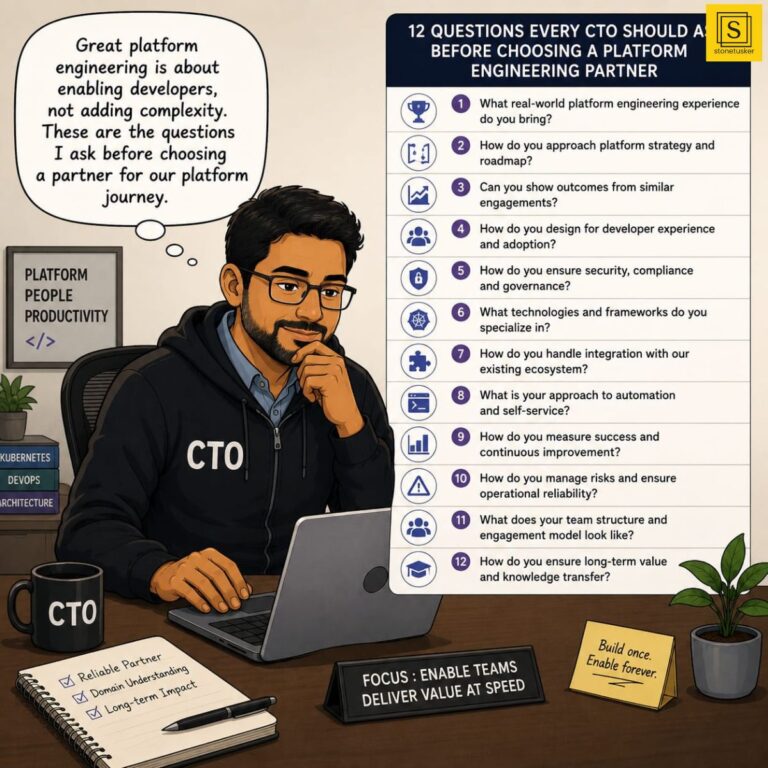
The CTO's Guide to Choosing the Right Platform Engineering Partner: 12 Questions Every Enterprise Should Ask
Enterprise platform projects rarely fall over because someone picked the wrong tool. They fall over because someone picked the wrong partner to deliver them.
Engineering leaders today have an enormous ecosystem to draw on. Kubernetes, Terraform, GitHub Actions, Backstage, Argo CD, and a long list of cloud-native platforms behind them. On their own, these tools are mature, capable and widely used. And yet a lot of platform modernisation programmes still fail to deliver what the executives were promised.
The technology is rarely the culprit. What usually goes wrong is how the technology gets introduced, adopted and governed across the organisation.
Building a real platform engineering capability takes far more than standing up a few Kubernetes clusters or automating a pipeline. It needs a clear grip on how software actually gets delivered, where developers lose time, which operational bottlenecks exist, and what outcomes leadership is actually after. Miss that wider picture and you end up with an expensive pile of tools that developers avoid, platform teams dread maintaining, and leadership cannot justify.
A good platform engineering partner works the other way round. Before touching technology, they look at how your teams deliver software today, where the friction lives, and what the business is trying to achieve. Only then do the technology decisions follow. The goal was never to build another Kubernetes platform. It was to help developers ship faster, tighten governance, simplify operations and reduce risk.
An inexperienced consultant tends to do the opposite. They lead with tools. Kubernetes becomes the project rather than the thing that supports the project, and the organisation spends a serious budget on modern tooling while deployment frequency, developer experience and efficiency barely move.
So choosing a platform engineering consulting company is a strategic decision, not a procurement box to tick. The right partner leaves behind a capability your teams can own and grow. The wrong one leaves behind a tangle of technology that needs their invoice attached to it forever.
These are the twelve questions every CTO, CIO and engineering leader should ask before signing. They go past technical skill and get at what actually decides whether a platform succeeds: outcomes, adoption, governance, operational maturity and measurable delivery improvements.
Assess your engineering maturity before choosing a partner
Before you buy tools or sign a consultant, it helps to know where your organisation actually stands. Spotting your deployment bottlenecks, governance gaps and developer experience problems lets you focus spend on the improvements that move the needle.
Why the Right Partner Matters More Than the Right Tool
A lot of organisations kick off their platform journey by comparing technologies. They line up Kubernetes distributions, service meshes, GitOps platforms, Infrastructure as Code tools and developer portals, all before agreeing on what those technologies are supposed to achieve.
That technology-first habit usually just adds complexity.
A platform engineering programme should produce results you can measure: faster delivery, lower deployment risk, more productive developers, stronger governance. Technology can enable all of that. It does not guarantee any of it.
The partner you pick will shape your platform architecture, your engineering practices, your operating model, developer adoption and how maintainable the whole thing is years later. Their experience often decides whether you get a genuine engineering capability or another underused infrastructure bill.
1. Do They Start With Business Outcomes or With Technology?
The first question tells you almost everything.
Listen to how a partner opens the conversation. If they start describing their reference architecture, their preferred Kubernetes distribution or the developer portal they always install, you are talking to a tool installer. If they start by asking how your teams ship software, where releases stall and what leadership is trying to fix, you are talking to an engineer.
A strong partner treats technology as the last decision, not the first. They want to understand the problem before they reach for a solution, because the same tool can be the right answer in one organisation and a costly mistake in another.
Questions to ask
- What do you need to understand about our business before recommending anything?
- How do you connect platform work to outcomes leadership actually cares about?
- Can you describe a project where the right answer was not new technology?
- How do you decide what not to build?
What good looks like
The partner spends the early conversations on your delivery problems, not their product catalogue. They can explain how a platform decision ties back to deployment speed, developer time or business risk in plain language.
2. Do They Have Real Enterprise Platform Engineering Experience?
Plenty of consultancies can run a tutorial-grade Kubernetes cluster. Far fewer have carried a platform through the messy realities of a large organisation, with multiple teams, legacy systems, audit requirements and people who are understandably tired of change programmes.
Enterprise experience shows up in the details. How they handle brownfield environments. How they deal with security and compliance teams. How they keep delivery moving while the platform is still being built. This is very different from a greenfield demo.
Questions to ask
- Have you delivered platforms at our scale and in our industry?
- How do you work alongside teams that cannot stop shipping during the project?
- What went wrong on a previous engagement, and what did you change?
- Who on your team will actually be doing the work, and what is their background?
Evaluation tip
Ask who will be on the ground day to day. Some firms sell with senior architects and deliver with junior engineers. You want to meet the people who will still be there in month three.
3. Do They Design for Developer Experience?
A platform only works if developers actually use it. That sounds obvious, yet it is the single most common thing teams forget.
If using the platform is slower or more confusing than the workaround developers already have, they will quietly keep the workaround. Adoption is not something you announce. It is something you earn by making the supported path the easiest path.
A good partner treats developers as the customer of the platform and designs around their daily workflow: how they create an environment, how they deploy, how they debug, how they onboard on day one.
Questions to ask
- How do you gather developer feedback during the build, not just at the end?
- What does self-service look like for a developer on their first day?
- How do you measure whether developers find the platform easier than the old way?
- How do you avoid building something only the platform team understands?
What good looks like
The partner can describe the developer journey step by step, and they measure adoption as a real outcome rather than assuming teams will come around eventually.
4. Can They Handle Governance and Compliance?
A lot of engagements wrap up the moment pipelines run and Kubernetes workloads are healthy. Those are real milestones, but they are only part of what platform engineering should deliver.
As you grow, governance matters as much as deployment speed. Teams need room to move quickly, but that freedom has to sit inside clear guardrails. A mature partner builds those controls into the platform instead of leaning on manual reviews and inconsistent processes.
Governance should help developers, not slow them down. Bake security and compliance into the platform and teams can release with more confidence and less overhead.
Governance capabilities every enterprise platform should include
- Role-based access control to enforce least-privilege access across environments.
- Policy as Code to automate security and operational governance.
- Centralised secrets management that keeps credentials out of application code.
- Thorough audit logging for operational visibility and compliance reporting.
- Supply chain security controls that verify dependencies and container images.
- Automated compliance checks wired straight into deployment pipelines.
Questions to ask
- How do you implement governance without slowing developers down?
- How is Policy as Code built into the platform?
- How are secrets managed across environments?
- What controls exist for software supply chain security?
- How do you support our regulatory requirements?
What good looks like
Governance is designed in from the start. When security, compliance and access control are treated as things to bolt on after the fact, the debt piles up and gets harder to unwind every month.
5. Do They Simplify Tooling Instead of Adding More?
One of the biggest myths in platform engineering is that more tools make a better platform.
In reality, most engineering organisations already suffer from tool sprawl. Different teams run different CI/CD systems, provisioning tools, deployment platforms and monitoring stacks. Every new addition means more to maintain, more to learn and more that can break.
An experienced partner works to remove complexity, not pile on another set of technologies.
Warning signs of a tool-first approach
Some consultants want to introduce a fresh stack on every engagement: Vault, Istio, Argo CD, Flux, Jenkins, GitHub Actions, Terraform, Backstage, and so on.
Each of these is useful when it solves a real, specific need. Installing all of them without a clear operating strategy just creates maintenance work and a steeper learning curve for your engineers.
A good partner prioritises simplicity
Instead of asking "which new tool should we deploy?", a strong partner asks "which capability we already have solves this?" They look at your current landscape, find the overlaps and recommend consolidation where it makes sense.
A simpler platform tends to give you:
- Lower operational overhead.
- Faster onboarding for new developers.
- Less maintenance effort.
- More consistent engineering practices.
- Lower long-term infrastructure cost.
- Better adoption.
Need an Independent Platform Review?
If your teams are wrestling with fragmented tooling, inconsistent pipelines or platform complexity, an engineering-led strategy discussion can surface practical improvements before you add yet another technology.
6. Do They Measure Success?
Technology projects often end with infrastructure deployed, documentation handed over and milestones ticked off. None of that tells you whether the platform actually improved software delivery.
A mature platform engineering services provider agrees on measurable success criteria before implementation starts, then keeps tracking them throughout. Without objective numbers, you cannot tell whether you improved engineering performance or just installed something new.
Core metrics every platform initiative should track
- Deployment frequency, to see how often software reaches production.
- Lead time for changes, to measure commit to production.
- Mean time to recovery, to gauge resilience after incidents.
- Change failure rate, to watch deployment quality and release stability.
- Developer onboarding time, to see how quickly new engineers become productive.
- Platform adoption rate, to measure how many teams actually use the platform.
Questions to ask during evaluation
- Which metrics do you establish before implementation?
- How do you set performance baselines?
- How often are metrics reviewed with stakeholders?
- What executive reporting is included?
- How do you measure developer adoption?
Evaluation tip
If a partner cannot clearly explain how success will be measured, they are effectively asking you to approve an engineering investment with no definition of what a win looks like.
7. Will They Transfer Knowledge?
A good engagement leaves your organisation stronger than it found it. Some firms do the opposite, keeping the important knowledge inside their own team. That guarantees them repeat business, but it leaves you unable to run or evolve your own platform.
An experienced partner wants your engineers confidently managing, extending and improving the platform once they leave. Knowledge transfer is not a workshop crammed into the final week. It runs through the whole engagement, so your team gradually takes ownership as the platform matures.
Questions every CTO should ask
- What happens after the engagement ends?
- Will our engineers be able to run the platform on their own?
- What documentation will we get?
- How are platform administrators trained?
- Do developers get enablement sessions?
- Is knowledge transferred throughout, or only at the end?
What effective knowledge transfer includes
- Thorough platform documentation.
- Architecture decision records that explain the key choices.
- Operational runbooks for common maintenance work.
- Incident response procedures.
- Developer onboarding guides.
- Hands-on workshops for platform engineers and application teams.
- Shadowing sessions where your engineers gradually take the wheel.
What good looks like
The best engagements end with your internal teams confidently handling deployments, upgrades, governance policies and developer support. The partner becomes an advisor you call when you want to, not a dependency you cannot shake.
8. Can They Work With What You Already Have?
Enterprise environments are almost never a blank page. Most organisations have already invested heavily in cloud platforms, CI/CD systems, monitoring, Infrastructure as Code, security tooling and identity management.
A partner who wants to replace all of it should set off alarm bells.
Modern enterprise platform engineering evolves what already works wherever it can. Tearing out mature systems without a strong business case just adds cost, delays adoption and raises risk.
A good strategy builds on existing strengths
Experienced consultants start with a proper assessment of your current delivery ecosystem. They work out what already works well, what needs improvement and what genuinely has to go.
They typically look at:
- CI/CD platforms.
- Source code management.
- Cloud infrastructure.
- Container platforms.
- Infrastructure as Code practices.
- Monitoring and observability.
- Identity and access management.
- Security tooling.
Rather than forcing disruption, a capable partner lays out an incremental modernisation roadmap that gets the most from what you have already paid for while fixing the bottlenecks.
Questions worth asking
- Which of our existing technologies can stay?
- How do you keep disruption low during migration?
- Can modern practices be introduced incrementally?
- How do you reduce migration risk?
- What is essential to change, and what is optional?
Evaluation tip
Modernisation should feel evolutionary, not like a demolition. A partner who wants to replace every tool before understanding your environment is usually solving a technology problem rather than your business problem.
9. Do They Have a Practical Roadmap?
Good platform programmes are built from a series of manageable improvements, not one giant infrastructure project. A clear roadmap helps teams see the priorities, keeps stakeholders aligned and shows measurable progress at regular points.
Every organisation's path is different, but an experienced consultant should be able to walk you through a phased plan rather than wave at a vague long-term vision.
A typical 90-day platform engineering roadmap
| Phase | Timeline | Primary objectives |
|---|---|---|
| Assessment | Weeks 1 to 3 | Evaluate the current engineering landscape, find delivery bottlenecks, assess governance, review developer workflows and set baseline metrics. |
| Platform design | Weeks 4 to 7 | Define the platform architecture, standardise delivery workflows, set governance controls, agree priorities and draft the Internal Developer Platform blueprint. |
| Enablement and adoption | Weeks 8 to 12 | Build priority capabilities, onboard teams, transfer knowledge, measure adoption and check improvements against the agreed metrics. |
A phased approach lowers risk and lets teams feel benefits early. It also leaves room to fold in developer feedback before rolling the platform out more widely.
Questions to ask about the roadmap
- How is the engagement structured?
- When can we expect measurable outcomes?
- How are priorities decided?
- How are risks managed during implementation?
- What milestones mark progress?
A detailed roadmap shows the partner has a repeatable method rather than making it up as they go.
10. Ask for References, Not Just Logos
Almost every consultancy has a wall of impressive client logos. Recognisable brands might hint at experience, but they tell you very little about the quality of the work or the results.
When you evaluate a platform engineering partner, ask to speak to previous clients. A real conversation with an engineering leader who has been through a similar transformation beats any case study or slide deck.
A credible partner should be happy to connect you with references where confidentiality allows. Those calls help you check not just technical skill but collaboration, communication and lasting value.
Questions to ask customer references
- What engineering problems were you trying to solve?
- How did the team approach the work?
- Did the platform actually improve developer productivity?
- Was it delivered against the agreed roadmap?
- How well did they communicate with engineering leadership?
- Did they transfer enough knowledge to your internal teams?
- Would you work with them again?
Pay attention to how past customers describe the team's ability to understand the business, work with internal engineers and adapt when things changed. Those qualities tend to matter more than raw technical expertise.
Evaluation tip
Strong references usually point to measurable improvements in delivery, developer experience and operational maturity, not just praise for technical skill.
11. Red Flags to Watch For
Not every engagement delivers lasting value. Some add needless complexity. Others fail because they skip governance, developer adoption or the human side of change. Spotting the warning signs early saves you an expensive mistake.
Common warning signs
- The conversation is almost entirely about tools rather than outcomes.
- There is no structured assessment phase before a solution is proposed.
- Governance, compliance and security barely come up.
- Developer experience and adoption are not discussed.
- No engineering metrics are defined to measure success.
- Executive reporting and stakeholder communication are missing.
- Knowledge transfer is treated as optional.
- The roadmap has no clear milestones.
- The plan replaces existing technology with no clear business case.
- The team cannot explain how they reduce operational complexity.
One or two of these will not always rule a partner out. But if several show up during evaluation, look at other providers before committing to a long engagement.
12. The Final Decision Checklist
Before you choose a platform engineering consulting partner, hold every candidate to the same objective criteria. A structured checklist keeps your decision consistent and helps you separate marketing from real delivery capability.
| Evaluation criterion | What a strong partner demonstrates |
|---|---|
| Starts with business outcomes rather than technology | Opens with your delivery problems and ties platform work to business goals. |
| Proven enterprise platform engineering experience | Has delivered at your scale, in brownfield environments, alongside busy teams. |
| Designs with developer experience as a priority | Can describe the developer journey and measures adoption as an outcome. |
| Builds governance, security and compliance in | Treats guardrails as part of the platform, not a later add-on. |
| Simplifies tooling instead of adding to it | Consolidates overlap and justifies every new tool. |
| Defines measurable engineering success metrics | Sets baselines and reviews DORA-style metrics with stakeholders. |
| Provides thorough knowledge transfer | Documents, trains and hands ownership over throughout the engagement. |
| Works with existing technology investments | Assesses before replacing and modernises incrementally. |
| Follows a structured implementation roadmap | Phased plan with clear milestones and early wins. |
| Can provide credible customer references | Willing to connect you with engineering leaders who have done this. |
No two partners will look the same, but the strongest candidates consistently show technical depth, operational maturity and a clear focus on measurable business outcomes rather than just installing new technology.
Typical Outcomes Teams Measure After Working With the Right Partner
- Engineering teams often cut deployment lead times by standardising delivery workflows and automating repetitive operational tasks.
- Developers spend less time waiting on infrastructure or untangling environment inconsistencies once self-service is in place.
- Platform teams gain stronger governance by embedding security policies, access controls and compliance checks into everyday workflows.
- Engineering leaders get real visibility into delivery through consistent measurement of deployment frequency, lead time, change failure rate and adoption.
- Internal teams become more self-sufficient through structured knowledge transfer and operational enablement.
Key Takeaways
- Platform programmes usually fail on the partner, not the technology.
- A strong partner starts with business outcomes and treats technology as the last decision.
- Developer experience decides adoption, so the supported path has to be the easiest path.
- Governance, security and compliance belong inside the platform, not bolted on later.
- Good partners simplify tooling and build on your existing investments instead of replacing everything.
- Success should be measured with objective metrics agreed before the work starts.
- Real knowledge transfer leaves your team able to own and evolve the platform alone.
Conclusion
Choosing a platform engineering partner is not about finding a consultancy that knows Kubernetes, GitOps or Infrastructure as Code. Those matter, but they are only enablers. The real goal is to improve how software gets delivered across your organisation.
The right partner starts with your business objectives, your engineering workflows and your operational challenges before recommending any technology. They simplify developer experience, build governance into the platform, cut operational complexity and help your teams get more productive over time.
Just as important, they leave you with a lasting capability rather than a stack that needs their support forever. Through proper knowledge transfer, measurable success metrics and a practical roadmap, they hand your teams a platform they can own and grow.
Ask the twelve questions in this guide and you can judge partners objectively, on the traits that consistently lead to successful platform programmes rather than on a slick demo. In the end, the best engagements are measured not by how many tools got installed, but by the improvements they deliver in software delivery, developer productivity, governance and engineering efficiency.
Planning a Platform Engineering Initiative?
Before you invest in more tools or sign a consulting partner, get a clear read on your current engineering maturity and the improvements that will deliver the most value.
About the Author
Subeesh Sivanandan is Founder and CEO of Stonetusker Systems, with more than 26 years helping enterprise engineering teams improve software delivery through DevOps, CI/CD, Platform Engineering, Release Engineering, Infrastructure Automation and DevSecOps.
Over his career he has worked with organisations including Stryker, Nokia, IP Infusion, VeriSign and CMC Ltd, delivering engineering transformation across healthcare, networking, embedded systems and enterprise software.
His areas of focus include platform engineering, Kubernetes operations, Infrastructure as Code, CI/CD modernisation, cloud infrastructure, engineering productivity and operational automation.
Frequently Asked Questions
1. What does a platform engineering consulting company actually do?
A platform engineering consulting company helps organisations design, implement and improve internal engineering platforms that make software delivery easier. The work usually covers platform architecture, CI/CD modernisation, Infrastructure as Code, Kubernetes operations, developer self-service, governance, security integration and engineering enablement. The point is to lift developer productivity while cutting operational complexity and making delivery more reliable.
2. How is platform engineering different from traditional DevOps consulting?
DevOps consulting tends to focus on automating build, test and deployment pipelines. Platform engineering goes further by building a reusable Internal Developer Platform with standardised workflows, self-service infrastructure, governance and guardrails. The focus shifts from one-off automation projects to a platform that supports many teams consistently.
3. What qualities should I look for in a platform engineering partner?
Look for a partner that starts with business outcomes rather than tool selection. They should have real enterprise experience, put developer experience first, build governance into the platform, measure engineering performance with objective metrics and transfer knowledge properly. They should also build on your existing investments instead of ripping everything out.
4. How long does a typical platform engineering implementation take?
It depends on the size of the organisation, engineering maturity and scope. Most teams start with an assessment and platform design phase, then roll out priority capabilities over several months. The programmes that succeed take an incremental approach that delivers measurable wins early instead of one large disruptive project.
5. How do organisations measure the success of a platform engineering initiative?
Success is usually tracked with engineering performance indicators such as deployment frequency, lead time for changes, change failure rate, mean time to recovery, developer onboarding time and platform adoption. These give objective evidence that the platform is improving delivery, productivity and reliability while supporting wider business goals.

