
Open Source DevOps & CNCF Integration
Your Toolchain Shouldn’t
Cost More Than It Saves.
Proprietary DevOps tooling comes with per-seat pricing, vendor roadmaps you don’t control, and migration costs that grow as you scale. We integrate CNCF and open-source tools — ArgoCD, Prometheus, Grafana, Tekton, Terraform — with the same enterprise reliability most teams pay a licence fee to get, without the lock-in that makes switching painful later.
No retainers · NDA before any technical discussion · 30-minute call, no pitch deck
Open source isn’t cheaper because it’s free. It’s cheaper because it’s honest.
Proprietary DevOps platforms have a model: get teams dependent on the interface, raise prices at renewal, and make migration expensive enough that nobody does it. Most teams that pay for Azure DevOps, Bitbucket, or Bamboo aren’t paying for features they couldn’t get elsewhere. They’re paying for inertia.
Open-source and CNCF tools have been production-ready at enterprise scale for years. ArgoCD manages Kubernetes deployments at some of the largest companies in the world. Prometheus powers observability stacks that handle billions of metrics. The gap between open-source and enterprise tooling closed a long time ago. What’s left is the integration work — which is what we do.
From the manufacturing firm CNCF toolchain engagement
The stack
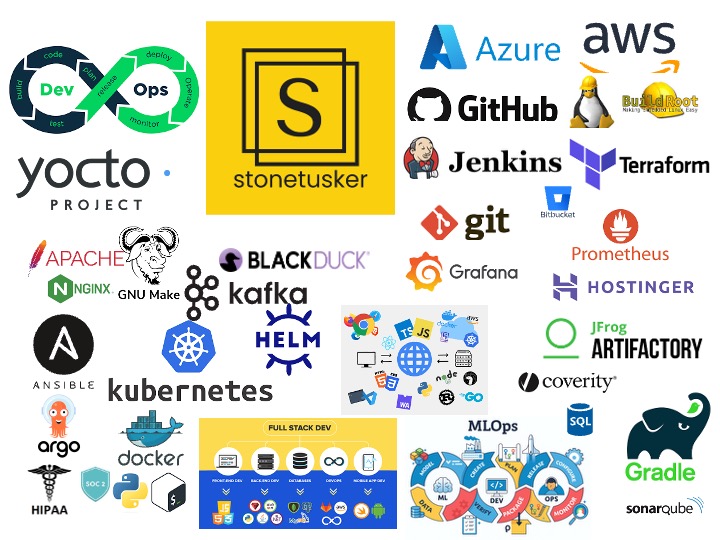
CNCF and open-source tools we integrate and manage
Every tool we recommend is production-ready, CNCF-backed where relevant, and selected for your specific stack — not pulled from a fixed template.
What the engagement covers
Five engagement types, including migration from paid tooling
Published case study
CNCF Toolchain Modernisation for a Global Manufacturing Firm
A global manufacturing client was running fragmented CI/CD systems across business units, with monitoring handled by separate paid tools and no unified visibility across services. Engineers were switching between interfaces to debug a single incident. We replaced the entire toolchain with an open-source stack: Jenkins for CI, ArgoCD for GitOps deployments, Prometheus and Grafana for observability across all 40+ microservices. Tooling costs dropped 45% in the first year. Deployment velocity improved 60%. The engineering team now operates the full stack without outside support.
What the client said
We were paying for three separate tools that still didn’t give us a complete picture of our deployments. Stonetusker replaced all of them with an open-source stack that does more, costs less, and our engineers actually understand how to operate.
Director of Engineering Global Manufacturing Firm
The engagement
How an open-source toolchain integration actually runs
We audit your current toolchain and what it costs
Two weeks reviewing what you’re running, what each tool costs, what it covers, and what gaps exist between tools that nobody has formally identified. We also look at what your team actually uses versus what’s been paid for and left idle. We sign an NDA before this starts. Your architecture and tooling decisions stay confidential.
We design the open-source toolchain with your engineers
Tool selection, integration architecture, GitOps workflow design, and observability stack layout — all designed collaboratively with your team, not handed over as a recommendation document. Your engineers understand why each tool was chosen before we start deploying it. That understanding is what makes handover actually work.
We deploy and integrate, staged to avoid disruption
If you’re migrating from existing tooling, the integration is staged — new tools go live alongside old ones so nothing breaks in production during the switch. Your team keeps shipping throughout. Once a stage is validated, the old tool is retired. Nothing is a big-bang cutover.
We validate pipelines under real load before stepping back
Before handover, every pipeline is tested against real deployments, observability alerts are calibrated against actual traffic patterns, and security policies are validated against your real workloads. We don’t hand over a toolchain that’s only been tested in a sandbox.
Ongoing support is available but most teams don’t need it
Managed upgrade support, scaling assistance, and tool maintenance are available post-engagement without a long-term retainer. Runbooks covering upgrades, failure modes, and scaling events are all delivered before we step back. Teams that go through the full engagement typically handle their own operations within 60 days.
See one open-source tool replace your most expensive paid one before committing to the full stack.
A 2 to 3 week paid pilot that integrates one open-source tool from your target stack into your real environment — not a sandbox. You see it working before you decide to replace anything else.
Pilot guarantee
If the pilot doesn’t deliver a working open-source integration into your actual environment, you don’t pay for the full engagement.
The pilot produces a real integration — running against your actual workloads, not demonstrated on a sample project. If it doesn’t, you don’t pay for the next phase. That’s in the agreement before the pilot starts.
Questions about open source at enterprise scale
This is a fair concern and the honest answer is: sometimes yes, sometimes no. The question is whether your current paid tool is actually being maintained for you, or whether you’re paying for a UI while your engineers still handle configuration, upgrades, and failure modes themselves. For most teams we audit, the maintenance overhead of open-source tools is lower than expected because CNCF projects like ArgoCD and Prometheus have large communities, excellent documentation, and stable upgrade paths. We also deliver runbooks covering the maintenance tasks that come up regularly, so your team isn’t starting from scratch when something needs attention.
If it works fine and the costs are predictable, the answer might be: don’t. We start with the toolchain audit specifically so we can give you an honest answer about where switching makes financial sense and where it doesn’t. Not every team should migrate everything. The most common pattern is a hybrid approach — keeping the tools that have deep integration with your existing workflows and replacing the tools where open-source alternatives are clearly better and cheaper. If the audit shows Azure DevOps is giving you good value, we’ll say so.
The CNCF graduation process is one of the more rigorous security reviews in the software industry. Graduated projects like Kubernetes, Prometheus, and ArgoCD have gone through multiple independent security audits, have dedicated security teams, and have CVE disclosure processes that are often faster than commercial vendors. Some of the security tools in our stack — Trivy, Falco, OPA — are specifically designed for regulated and enterprise environments and are used by financial services and healthcare organisations with strict compliance requirements. We can provide security documentation for any tool we recommend and scope compliance validation into the engagement if your industry requires it.
Stop paying licences for tools your engineers barely use.
30 minutes. We arrive having looked at your public stack and will tell you which tools are worth replacing first and what the savings would look like in year one.
No retainers · No lock-in · NDA signed before we discuss your architecture
30-minute call · No pitch deck · We come prepared for your specific toolchain
Not ready yet? Get your free DevOps health score with TuskerGauge™ →